
Self-Leadership vs. Servant Leadership: You Can't Serve What You Can't Lead
Aug 20, 2026
I once spoke with a newly promoted VP who prided herself on being a servant leader. She answered every message within minutes. She took on her team's overflow work rather than push back on an unrealistic deadline. She canceled her own coaching sessions twice because "someone needed her more."
Eighteen months later, she was burned out, resentful, and privately furious that nobody on her team seemed to notice how much she was sacrificing.
She wasn't practicing servant leadership. She was practicing self-abandonment with better branding.
This is the confusion I see most often among the leaders I coach, from Singapore Airlines to Microsoft or Deloitte: servant leadership is treated as an alternative to self-leadership, when it's actually downstream of it. You cannot sustainably serve a team, a company, or a community with a self you haven't first learned to lead.
What self-leadership and servant leadership actually are
Self-leadership is the practice of intentionally influencing your own thinking, feeling, and actions toward your objectives (Bryant & Kazan, 2012). It's an inside job. The question it answers is: How do I direct my own behavior, thinking, and motivation, regardless of what title I hold?
Servant leadership, a term Robert Greenleaf coined in 1970, flips the traditional power relationship. Instead of people serving the leader, the leader exists to serve the people. It's explicitly other-oriented: prioritizing followers' growth, sharing power, and building trust rather than compliance.
They sit on the same ethical foundation: self-awareness, personal responsibility, and growth over ego, but they answer different questions. One governs you. The other uses your position to develop everyone around you.
Where they overlap
Both traditions value the same underlying moves, just aimed in different directions:
- Self-awareness and intentional choice. Neither self-leadership nor servant leadership works on autopilot. Both require you to notice your patterns before you can change them.
- Personal responsibility over positional authority. Neither approach lets you hide behind your job title. A self-led person owns their outcomes; a servant leader owns the conditions their team operates in.
- Growth as the point, not a side effect. Self-leadership builds your own capacity. Servant leadership actively builds other people's capacity. Same engine, different fuel line.
- Empowerment over control. A self-led person takes ownership of their work. A servant leader creates the conditions in which others can take ownership of their own.
- Long-term impact over short-term compliance. Both trade the quick win for the durable one.
Where they diverge
The distinction that matters most
Self-leadership is not selfish leadership. It means taking responsibility for your attention, your emotions, your standards, and your development, so that what you bring to other people is deliberate rather than reactive.
Servant leadership is not self-erasure. It means using your authority as stewardship, not making yourself indispensable or saying yes to every request that lands on your desk.
Put simply:
Self-leadership is the inner practice of leading yourself. Servant leadership is the relational practice of leading others through service. The second cannot survive long without the first.
Why I trust this the way I do
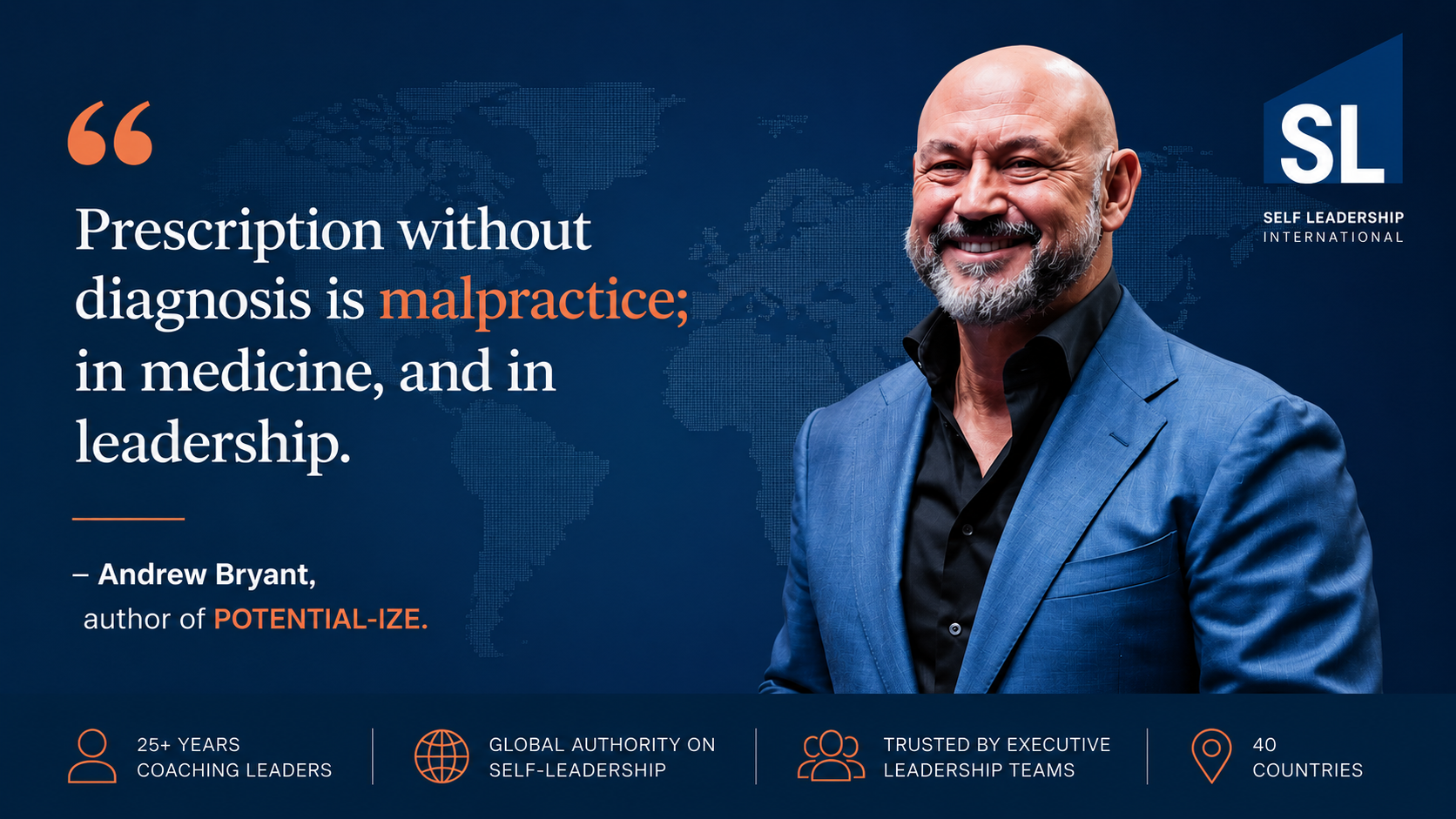
Before I was a leadership speaker and coached executives, I was a physiotherapist working with elite athletes. The rule in that environment was unforgiving: prescription without diagnosis is malpractice. You do not touch a treatment plan until you've correctly identified what's actually going on. Guess, and you make the injury worse.
Leadership has the same rule, and most people skip the diagnosis. They see a struggling teammate or a missed deadline and jump straight to "serving": taking on the work, smoothing it over, protecting people from consequences. That's prescription without diagnosis. It feels generous. It's often malpractice because it treats the symptom (someone is stressed) rather than the underlying condition (the system, priorities, or boundaries need to change).
A self-led person diagnoses first, in themselves and in the situation, before they act. That's what makes their service to others sustainable instead of theatrical.
What this looks like when a team misses a deadline
Picture a team that just missed an important deadline.
A self-led individual contributor notices their own defensiveness rising, reviews what they actually controlled, identifies where the planning broke down, communicates it clearly, and adjusts their own working system.
A servant leader does all of that, then goes further: asks what obstacles the team ran into, listens without assigning blame, removes the barriers that are in their power to remove, clarifies priorities, and gives people the resources and authority to do better next time, while holding everyone, including themselves, accountable for the outcome.
The first response centers self-regulation. The second applies that same self-regulation in service of others' growth and the team's shared mission. Skip the first step and the second one collapses into either blame or rescue.
The leaders who get this wrong
The over-functioning servant leader is one of the most common derailers I see in coaching, particularly among leaders who were promoted for being excellent individual performers and never rebuilt their operating model for a role that now runs through other people. They mistake exhaustion for virtue. They confuse being needed with being effective.
This pattern shows up right next door to a few other diagnostic gaps I see constantly: leaders who treat psychological safety as something a team owes them rather than something they help build, leaders who skip the self-awareness work that would let them see the difference between genuine service and self-sacrifice in the first place, and leaders who try to adopt transformational leadership behaviors directly, without first building the self-leadership foundation those behaviors actually run on.
Real servant leadership, the kind that produces engaged teams and durable trust, is not about carrying everyone else's load. It's about having led yourself well enough that you can see clearly what other people actually need, and being disciplined enough to give it to them instead of what makes you feel useful.
If you want a structured way to build that discipline, this is the territory the IGNITE Framework in my latest book, POTENTIAL-IZE, was designed for: developing the self-leadership capacity that must exist before service to others becomes sustainable rather than self-destructive.
FAQ: Self-leadership and servant leadership
Is servant leadership the same as self-leadership?
No. Self-leadership is the practice of directing your own thinking, feeling, and actions toward your goals. Servant leadership is the practice of using leadership authority to serve and develop other people. They share the same ethical foundation but point in different directions, one inward, one outward.
Can you be a servant leader without first practicing self-leadership?
Not sustainably. Without self-awareness, self-regulation, and clear boundaries, "serving" others tends to slide into people-pleasing, rescuing, or burnout rather than genuine empowerment. Self-leadership is what makes servant leadership durable instead of a fast track to exhaustion.
Does servant leadership mean putting yourself last?
No. That's the most common distortion of the model. Servant leadership means using your position to grow other people's capacity and agency, not erasing your own needs, standards, or accountability in the process.
What's the biggest risk of servant leadership done badly?
Self-sacrifice without boundaries. Leaders who equate "serving" with saying yes to everything end up over-functioning, under-delegating, and quietly resentful, which erodes the trust servant leadership is supposed to build.
How do I start developing self-leadership before I try to lead others?
Start with self-awareness: notice your default reactions under pressure before you try to change them. Self-Awareness at Work: The Leadership Skill You Think You Have (But Probably Don't) walks you through the three drivers of self-leadership.
Building This in Your Team
This is exactly the tension I help leadership teams work through, whether that's through 1:1 executive coaching, a workshop built around the self-leadership model, or a keynote that gives your organization a shared language for the difference between serving and self-sacrifice.
Where to go from here
If this distinction is showing up in how you or your leaders operate, the fix isn't a new mission statement about service. It's rebuilding the self-leadership foundation underneath it. That's the work I do in executive coaching and in POTENTIAL-IZE (Wiley, 2026), and it's the argument at the center of the original research behind Self Leadership (Bryant & Kazan, McGraw-Hill, 2012).
You cannot build servant leadership, or any other leadership style, on top of a leader who hasn't first learned to lead themselves.
Turn Insight Into ActionReading about leadership can change what you know.Self-leadership changes what you do.Develop your leadership effectiveness → Explore Self-leadership Discover your leadership strengths & gaps → Choose an Executive Coach Unlock the potential of your team → Workshops & Masterclasses Ignite your event or conference → Book Andrew Bryant as your Leadership Speaker "Prescription without diagnosis is malpractice" |