
Self-Awareness at Work: The Leadership Skill You Think You Have (But Probably Don't)
Aug 13, 2026
Here's an uncomfortable number. Organizational psychologist Tasha Eurich has spent years studying self-awareness in professional settings, and her research keeps landing on the same finding: roughly 95 percent of people believe they are self-aware. The actual figure, once you test for it rather than ask for it, is closer to 10 to 15 percent.
Sit with that gap for a second. It means the vast majority of leaders reading this article are, in this exact moment, confidently wrong about how self-aware they are. Not incompetent. Not unintelligent. Just blind to a part of themselves that everyone around them can see clearly.
That gap has a price tag. A study by Green Peak Partners and Cornell University, tracking 72 senior executives across public and private companies, found that self-awareness was the single strongest predictor of overall executive success. Not IQ. Not years of experience. Not the ability to make tough calls under pressure. Self-awareness outperformed all of it.
If you have ever worked for a leader who couldn't read a room, couldn't take feedback without getting defensive, or seemed to have no idea their tone shut down every conversation they were in, you already know why this matters more than any other leadership competency. Skill without self-awareness just means your blind spots move faster.
Why self-awareness sits underneath everything else
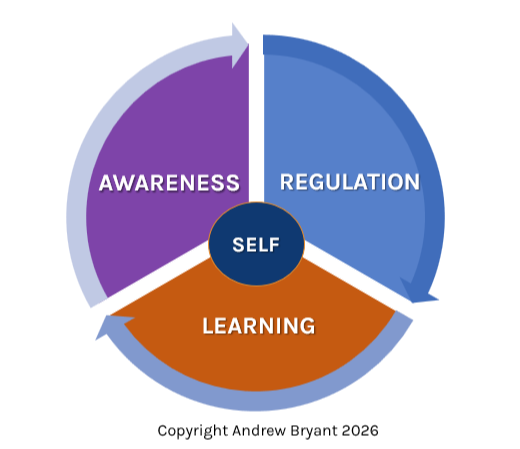
In my own framework for self-leadership, built from more than two decades of coaching executives across five continents, self-awareness is one of three core competencies, alongside self-regulation and self-learning. But it isn't just one competency among equals. It's the diagnostic layer the other two depend on.
You cannot regulate a reaction you don't notice you're having. You cannot learn from a gap you don't know exists.
Self-regulation and self-learning both operate blind without it. That's not a motivational line; it's a mechanical fact about how change works. Diagnosis has to come before treatment, in medicine and in leadership alike.
The good news is that self-awareness is trainable. It is not a fixed trait you either have or don't. It's a set of practices, and like any practice, it responds to repetition. Here are the four that actually move the needle, and the traps that quietly cancel them out.
1. Journaling: build the paper trail your memory won't keep
Your memory edits itself constantly to protect your self-image. Journaling is the antidote, because it captures what you thought and felt before your brain had the chance to clean it up.
The technique that works isn't "write about your day." It's targeted reflection tied to specific moments of friction. At the end of each day, or right after a charged meeting, answer three questions in writing:
- What triggered a strong reaction in me today, and what was the reaction actually about?
- Where did I speak or act on assumption rather than fact?
- What would someone who disagreed with me today say I got wrong?
That last question matters most. Most executive journaling stays comfortably self-affirming. Real self-awareness work requires you to actively argue against yourself on paper, on a schedule, whether you feel like it or not.
2. 360-degree feedback: the only data source that isn't you
Here's the trap in the Eurich research that most leaders miss: self-awareness has two halves, internal and external. Internal is knowing your own values and reactions. External is knowing how others actually experience you. Leaders who are strong in internal self-awareness but weak in external self-awareness are often the most confidently wrong because their inner narrative feels so coherent to them.
360-degree feedback exists to close that specific gap. But it only works if you design it to defeat politeness. Three rules make the difference:
- Ask behavioral questions, not character questions. "What do I do in meetings that shuts down debate?" gets you something usable. "Am I a good listener?" gets you a compliment.
- Guarantee anonymity and mean it. If a direct report can trace feedback back to themselves, you'll get the polished version, not the true one.
- Follow up with "what would you like to see instead?" People will tell you what's wrong more honestly than they'll tell you what to do about it, so ask both.
Then do the hardest part: say thank you and change nothing defensively in that first conversation. React badly once, and that feedback channel closes for good.
3. Mindfulness: widening the gap between stimulus and response
Viktor Frankl, the psychiatrist and Holocaust survivor, wrote that between stimulus and response there is a space, and in that space lies our power to choose our response.
That space is exactly what mindfulness practice trains you to notice and use.
You don't need a meditation cushion or thirty minutes a day for this to work in a professional setting. The version that transfers directly into leadership moments is the pause-and-name technique: the instant you feel a defensive spike, a flash of irritation, or the urge to interrupt, silently name what's happening. "That's defensiveness." "That's frustration about being second-guessed." Naming an emotion, rather than just feeling it, measurably reduces its grip on your behavior. Neuroscientists call this affect labeling. You can call it buying yourself half a second, which is usually all a leader needs.
Practiced consistently, this builds the exact muscle a difficult stakeholder meeting requires: noticing the reaction rising before it lands, and choosing something more constructive instead.
4. Behavioral reflection: review the tape, not the story
Journaling captures what you thought. Behavioral reflection captures what you actually did, which is a different and often less flattering dataset.
The simplest version of this is an After-Action Review, borrowed from the military and widely adopted in high-performing teams: after any significant meeting, negotiation, or decision, spend five minutes answering four questions, ideally with someone else in the room to keep you honest.
- What was supposed to happen?
- What actually happened?
- Why was there a difference?
- What will I do differently next time?
If you want to go further, record yourself in a rehearsal, a presentation, or a difficult one-on-one, and watch it back with the sound off first. Body language and facial expression tell you things your own internal narrative will happily skip over.
The trap underneath all four techniques
Every one of these practices can be hollowed out into performance. Journaling that only confirms what you already believe. Feedback you request but quietly punish. Mindfulness as a wellness habit disconnected from how you actually behave under pressure. Reflection that produces insight and no behavior change.
Self-awareness without action is just an expensive diary. The test isn't whether you understand yourself better this quarter. It's whether the people around you can see the difference.
Where this leads
Self-awareness is the entry point, not the destination. Once you can see your patterns clearly, the next question is what you do with that visibility: how you guide the people around you, how you build a team that can outgrow you, how you evaluate whether your leadership is actually working.
That's the territory I map out in the IGNITE Framework, the model at the center of my latest book, POTENTIAL-IZE (Wiley, 2026). IGNITE starts exactly where this article does, with self-awareness as the foundation, and builds outward through five more stages that turn personal insight into leadership that compounds. If the four techniques above are where you start, IGNITE is the structure for where you go next.
If you're building this skill as a founder specifically, where there's no manager to catch your blind spots for you, see Self-Leadership for Entrepreneurs: Lead Yourself First, Then Your Business for the daily practice built around exactly that.
And if you lead a team, self-awareness is also the diagnostic step behind the difference between genuinely serving people and just quietly absorbing their problems until you burn out, the distinction I draw out in Self-Leadership vs. Servant Leadership.
The same gap shows up when people can't seem to get motivated. It's rarely a discipline problem, it's usually that step one, visualizing an outcome you actually believe in, never happened. How to Get Your Motivation Back walks through the fix.
It's also the diagnostic step behind confidence: knowing exactly which of the four situations, managing down, across, up, or outward, is where your confidence actually breaks down, instead of treating "confidence" as one vague thing to fix. Leadership Confidence: How to Build It as a Manager walks through all four.
And it's the reason self-aware leaders decide faster, not just better: they've usually already done the work of knowing their own position before the meeting starts, instead of discovering it in real time. I go into that mechanism in Why Self-Leadership Makes Decisions Faster.
Frequently Asked Questions
Why is self-awareness at work the key to leadership success? A study by Cornell and Green Peak Partners of 72 executives found that self-awareness was the single strongest predictor of overall leadership success, ahead of IQ, experience, and even the ability to make tough calls. It works as the diagnostic layer beneath every other leadership skill: you cannot regulate a reaction or close a learning gap you cannot first see.
How can you improve self-awareness at work? Four practices build it reliably: targeted journaling that captures reactions before memory edits them, 360-degree feedback designed to surface honest behavioral input rather than polite praise, mindfulness techniques like pause-and-name that widen the gap between stimulus and response, and behavioral reflection tools like the After Action Review that check what you actually did against what you intended.
Turn Insight Into ActionReading about leadership can change what you know.Self-leadership changes what you do.Develop your leadership effectiveness → Explore Self-leadership Discover your leadership strengths & gaps → Choose an Executive Coach Unlock the potential of your team → Workshops & Masterclasses Ignite your event or conference → Book Andrew Bryant as your Leadership Speaker "Prescription without diagnosis is malpractice" |