
Self-Leadership and Transformational Leadership: Why One Doesn't Work Without the Other
Aug 22, 2026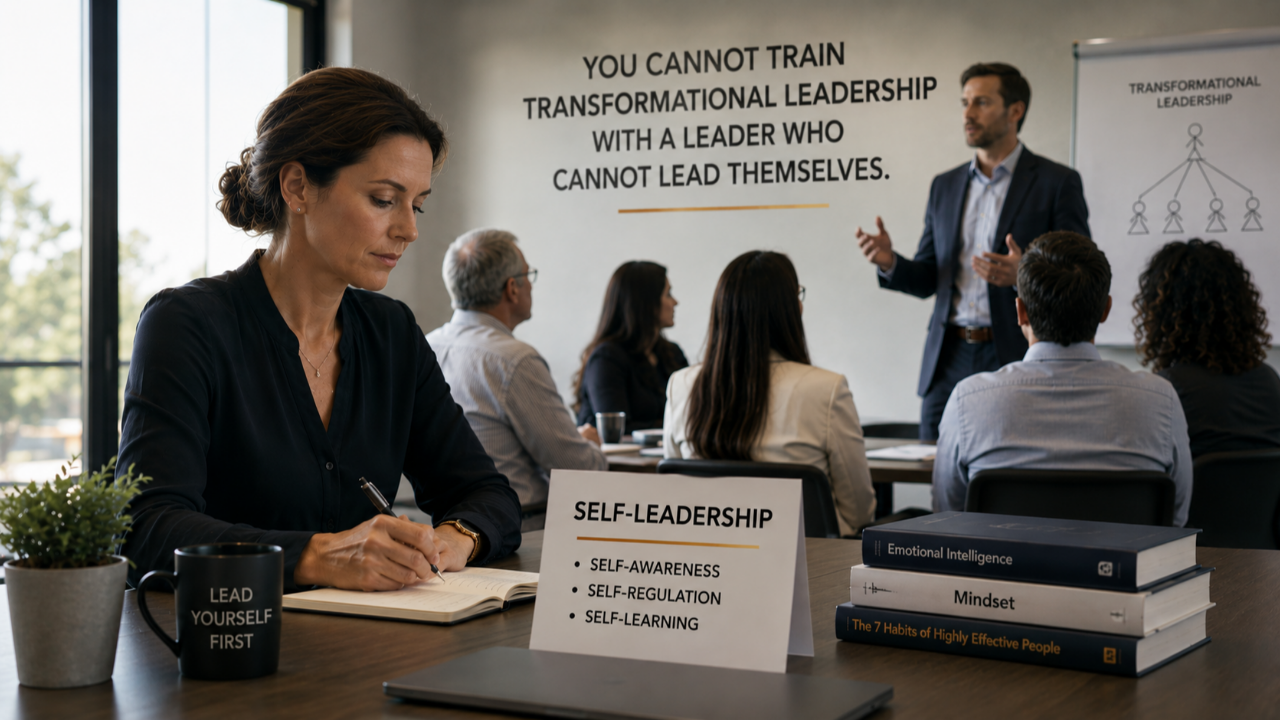
Transformational leadership is not a niche idea. It is the most studied leadership style in the entire field of organizational psychology, ahead of ethical leadership, servant leadership, and authentic leadership combined. Bernard Bass built the model into a science. Thousands of studies have tested it. Companies spend fortunes training leaders in its four behaviors.
And it fails constantly, in ways the research explains but the training rarely addresses.
I was first introduced to transformational leadership in the late 1990s, studying for an MBA at the University of Western Australia (UWA). At the time it felt like the answer. Here, finally, was a model that moved beyond the transactional carrot-and-stick style most of us had grown up watching in the workplace, toward something that treated people as more than a means to a target. I believed it then, and I still believe the model is right. What took me another two decades of coaching and research to understand is what the case studies and the four-behavior framework never mentioned: none of it works if the leader trying to practice it has not first done the work of leading themselves.
What Transformational Leadership Actually Asks of a Leader
James MacGregor Burns introduced the term in 1978, describing a relationship in which leaders and followers raise each other to higher levels of motivation and morality. Bernard Bass later gave it structure: four behaviors, known as the Four I's.
- Idealized Influence. The leader acts as a role model, someone whose values and behavior are consistent enough to be worth emulating.
- Inspirational Motivation. The leader articulates a vision compelling enough to pull people toward it, not push them.
- Intellectual Stimulation. The leader challenges assumptions, including their own, and invites people to think rather than comply.
- Individualized Consideration. The leader treats people as individuals with distinct needs, not as a category to be managed.
Read that list again. Every one of those behaviors requires the leader to already have a stable relationship with themselves. You cannot be a consistent role model without self-awareness of your own patterns. You cannot invite challenge to your own thinking without the self-regulation to not get defensive when it comes. You cannot give individualized attention to other people's development if you have never done the work of understanding your own.
This is not a metaphor. It is a measured relationship.
The Research: Self-Leadership Is the Mechanism, Not a Coincidence
In 2012, the same year my book Self Leadership was published, Andressen, Konradt, and Neck set out to answer a specific question: does self-leadership sit alongside transformational leadership as a separate input, or does it explain why transformational leadership works at all?
Using structural equation modeling, they found that self-leadership serves as a mediator between transformational leadership and employee motivation. In plain terms, transformational leadership behaviors do not directly motivate people. They work through the self-leadership capacity of the people who practice and receive them, and the effect is even stronger in virtual and distributed teams, where a leader's presence alone cannot compensate for the absence of that internal capacity.
Furtner, Baldegger, and Rauthmann pushed this further in 2013, framing self-leadership as the underlying mechanism beneath transformational, transactional, and laissez-faire leadership alike. And a large-scale meta-analysis by Lord and Hannah, drawing on decades of accumulated data, found self-leadership meaningfully associated with the personality traits and leadership behaviors that predict transformational leadership in the first place.
Here is the uncomfortable part for anyone who has sat through a transformational leadership workshop that produced enthusiasm on Friday and nothing by the following Wednesday.
You cannot train the Four I's of Transformational Leadership and expect them to stick, because they are not techniques. They are downstream expressions of a leader's relationship with themselves (self-leadership).
Idealized Influence is not a communication style; it is what self-regulation looks like from the outside. Intellectual Stimulation is not a facilitation technique; it is what self-awareness looks like when a leader is secure enough to be questioned.
As I put it in What Is Self-Leadership: you cannot build authentic leadership, transformational leadership, or servant leadership on top of a leader who cannot lead themselves. This is why.
Why the Newer Leadership Models Keep Circling Back to the Same Root
There is a finding in the leadership literature that deserves more attention than it gets. A 2022 evidence-based review by Deng and colleagues examined whether the newer leadership models- authentic, ethical, servant- add meaningful predictive value beyond transformational leadership. Their conclusion: not much. The models overlap heavily. Organizations chasing the latest leadership framework are often relabeling the same underlying construct.
I don't think that is because transformational leadership is the final word. I think it is because all of these models are downstream descriptions of the same upstream requirement: a leader who has done the internal work.
- Transformational leadership describes what that leader looks like when their attention is on inspiring a shared vision.
- Servant leadership describes what that same internal foundation looks like when their attention is on serving others' growth.
- Authentic leadership is characterized by a focus on consistency between values and action. Different lens, same foundation.
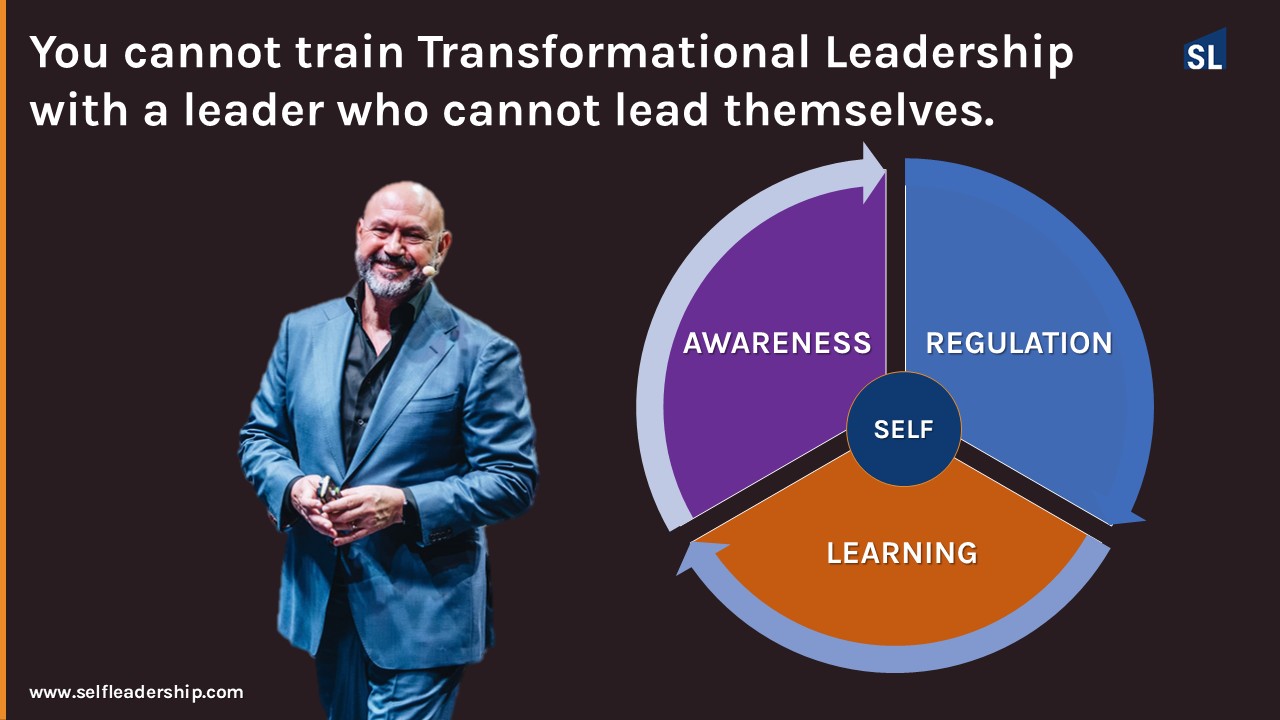
That foundation is self-leadership: the three-driver architecture of self-awareness, self-regulation, and self-learning that determines whether any leadership style survives contact with a hard Tuesday.
What This Looks Like in Practice
There's a quote from Bass that I love and often use in my role as a leadership speaker:
"There are almost as many definitions of leadership as there are people who have tried to define it."
This is ironic, as I have written a few leadership books myself. But self-leadership is more than a definition; it is a practice:
- It is the leader who has just delivered a vision to the team, the kind of moment transformational leadership training is built around, and then watches someone visibly disengage. The untrained response is to push the vision harder. The self-led response is to notice the disengagement without taking it personally, get curious about what it means, and adjust. That pause is self-awareness and self-regulation, and it is the difference between inspiration that lands and inspiration that performs well in the room and dies in the parking lot.
- It is the leader who invites intellectual challenge in a meeting, genuinely means it, and then receives a challenge that stings. Intellectual Stimulation as a slide in a training deck is easy. Intellectual Stimulation as a lived behavior, in the moment someone actually takes you up on it, requires the self-regulation to not shut the conversation down to protect your ego.
- It is the leader who wants to give individualized consideration to ten direct reports with ten different needs, and realizes that doing so consistently, especially under deadline pressure, is a self-learning problem as much as an empathy problem: it requires diagnosing where your own default patterns are getting in the way and closing that gap deliberately, not just wanting to be better at it.
The Practical Implication for Leadership Development
If your organization is investing in transformational leadership training and not seeing it stick, the research points to a specific diagnosis. The training is teaching behaviors without building the foundation those behaviors are supposed to sit on. As my early career as a physiotherapist to athletes taught me:
Prescription without diagnosis is malpractice.
Transformational leadership training is the prescription. Self-leadership development, self-awareness, self-regulation, and self-learning built in that order, is the diagnosis that has to come first.
This is also why self-leadership training compounds in a way that style-specific training does not. Build the foundation once, and every leadership style you later choose to express- transformational, servant, authentic- has something real to stand on.
The professor at UWA who taught me Organizational Leadership and Psychology was a great example of a Transformational leader. When I challenged him about the practicality of the models he was teaching, rather than getting defensive, he encouraged me by saying, "Do your own research, write your own book." That was the catalyst for my journey from physiotherapist to practitioner behind one of the most-cited definitions of self-leadership in the management literature.
Frequently Asked Questions
Is self-leadership a type of transformational leadership?
No. Self-leadership is an individual-level practice of intentionally influencing your own thinking, feeling, and actions (Bryant & Kazan, 2012). Transformational leadership is a leader-follower model describing how a leader influences others. Research shows that self-leadership serves as the mechanism that enables and sustains transformational leadership behaviors, but the two are distinct constructs.
Can someone be a transformational leader without strong self-leadership?
They can perform the behaviors briefly, particularly Inspirational Motivation, which rewards charisma in the short term. What the research on self-leadership as a mediating mechanism suggests is that the behaviors are harder to sustain under pressure and to make credible over time without the underlying self-awareness and self-regulation to back them up.
Why do transformational leadership training programs often fail to produce lasting change?
A 2024 systematic review by Tenschert, Furtner, and Peters found that standard leadership development programs often fail to move the core socioemotional skills, self-management and self-awareness, that other leadership models depend on. Training people in behaviors without first building that foundation is a common reason the training doesn't stick.
How is self-leadership different from the servant leadership model?
They answer different questions rather than compete. Self-leadership is the inner practice of leading yourself. Servant leadership is the relational practice of leading others through service. Transformational leadership is the relational practice of leading others through vision and inspiration. Self-leadership underlies both. Read the full comparison in Self-Leadership vs. Servant Leadership: You Can't Serve What You Can't Lead.
Want to Bring This to Your Organization?
If your leadership development strategy is built around transformational leadership and you want the foundation underneath it addressed directly, not skipped, that is the work I do. I have spent twenty-five years building the academic case for self-leadership and delivering it from the stage in more than forty countries, for organizations including Microsoft, Singapore Airlines, Airbus, and Deloitte.
Book Andrew Bryant as a Transformational Leadership Speaker →
Turn Insight Into ActionReading about leadership can change what you know.Self-leadership changes what you do.Develop your leadership effectiveness → Explore Self-leadership Discover your leadership strengths & gaps → Choose an Executive Coach Unlock the potential of your team → Workshops & Masterclasses Ignite your event or conference → Book Andrew Bryant as your Leadership Speaker "Prescription without diagnosis is malpractice" |