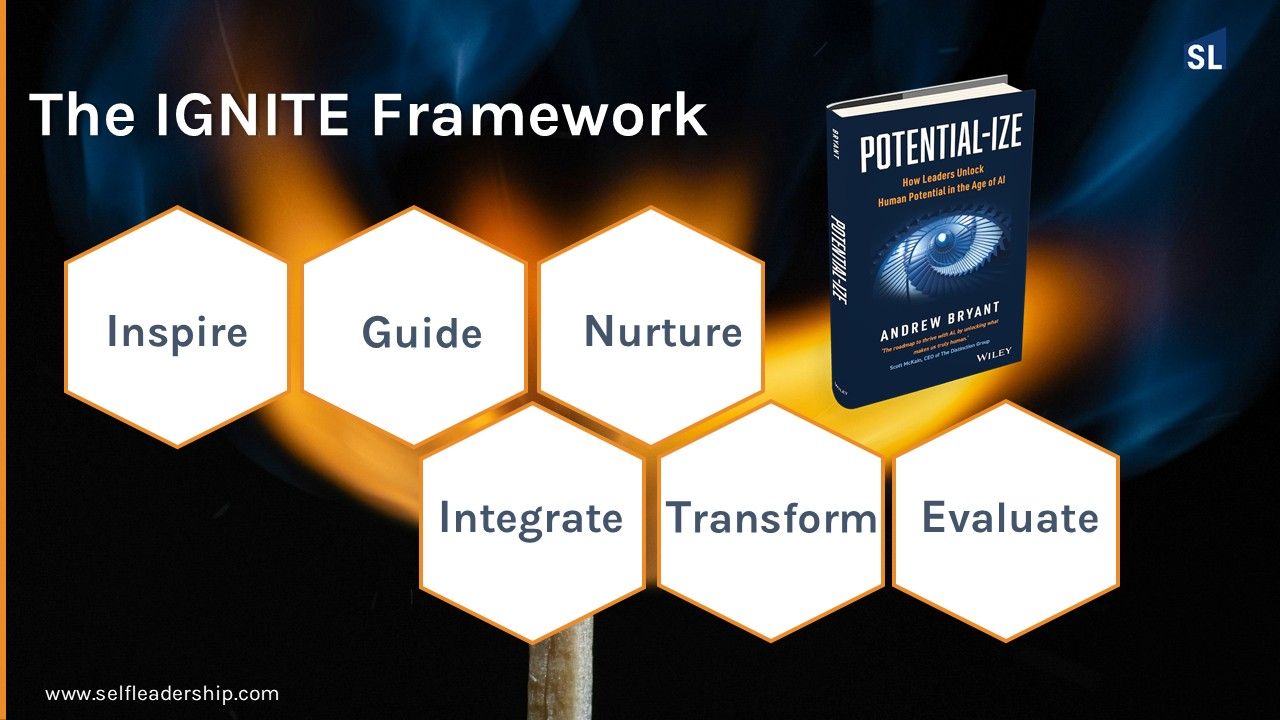
The IGNITE Framework
A Six-Element Methodology for Unlocking Human Potential and Leading Transformation in the Age of AI
Book Andrew to Speak →Most leadership development changes nothing. Here is why.
Organizations do not have a skills problem. They have a behavior change problem.
Every year, companies invest billions in leadership training. They bring in consultants, run workshops, send people on MBA programs, and distribute books. Most of it does not produce lasting change. The knowledge improves. The behavior does not.
I have been called in to fix failed interventions more times than I can count. The patterns are always the same. Generic content disconnected from real challenges. Facilitators who have never led at the level they are teaching. Events mistaken for processes. And underneath all of it, the same root cause: a failure to address the mindset that governs behavior in the first place.
Then AI arrived, and the stakes got higher.
The arrival of generative AI has not made human behavior change less important. It has made it more urgent. As AI absorbs the cognitive tasks that used to define knowledge work, the capabilities that remain distinctly human — judgment, empathy, the ability to inspire trust, the willingness to take accountability for outcomes — have become the last durable competitive advantage that organizations have.
The question is not whether your people can use AI tools. Most of them can. The question is whether they can lead in a world where their value is no longer their ability to process information, but their ability to do what AI cannot: inspire, guide, nurture, integrate, transform, and evaluate. That is precisely what the IGNITE Framework is built for.
Read about: Human Potential in the Age of AI →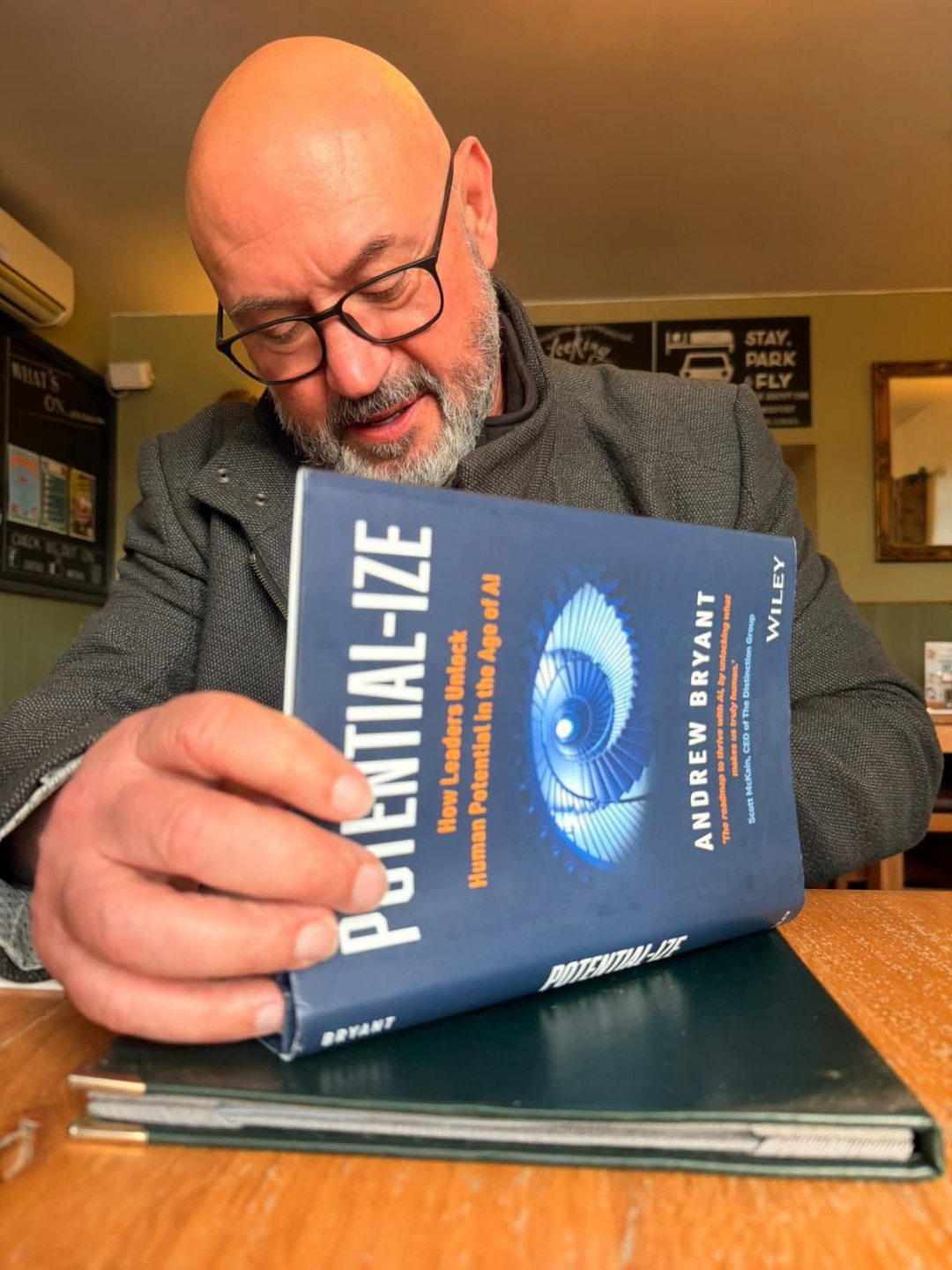
Six Elements. One Integrated System for Human Development

The IGNITE Framework is a six-element methodology for systematic human development in organizations navigating transformation, uncertainty, and the demands of the AI era. It is the operational core of POTENTIAL-IZE (Wiley, 2026) and the structure that underpins Andrew Bryant's coaching, keynote work, and enterprise leadership programs.
IGNITE is not a checklist. It is not a competency model. It is a sequenced system — each element building on the last — designed to close the gap between knowing and doing, and between intention and sustained behavior change.
The framework emerged from research across organizations that have successfully combined human potential with AI capability, including work with Microsoft, Salesforce, and Patagonia. It applies equally to individual executive development and to enterprise-wide transformation programs. And it is grounded in 25 years of self-leadership research and practice across 40+ countries.
The six elements are: Inspire. Guide. Nurture. Integrate. Transform. Evaluate.
Breaking Down the IGNITE Framework
I — Inspire Find your spark and take control of your story
Every transformation begins here. Not with a strategy document or a competency framework, but with meaning.
Inspire is about creating the emotional and intellectual context that makes change possible. People do not change because they are told to. They change because they can see themselves in a different story — one that matters to them, that connects to something they care about.
For leaders, this means two things. First, you must be clear about your own why: your values, your identity, your reason for doing this work. Without that clarity, everything else is borrowed motivation, and borrowed motivation runs out. Second, you must be able to inspire others — not through charisma or positional authority, but through the ability to make the future feel real and worth moving toward.
Stop leading with data. Start leading with narrative. Humans have not evolved to act on spreadsheets. We act on stories. The most effective leaders I have worked with are not the ones who give the best PowerPoint presentations. They are the ones who help their people see themselves differently.
G — Guide Navigate with wisdom through mentorship, feedback, and a clear roadmap
Inspiration without direction is enthusiasm without traction.
Guide is about providing a clear, credible roadmap for new behavior. It addresses one of the most consistent failures in leadership development: people understand the destination but have no map. They leave workshops motivated and return to their desks to find the same pressures, the same triggers, and the same habits waiting for them. Within 72 hours, the inspiration is gone.
The Guide element has two dimensions. Externally, it is about the leader's ability to provide clarity, direction, and the kind of feedback that accelerates rather than shuts down development. Most leaders are genuinely poor at feedback. They either avoid it entirely or deliver it in ways that trigger defensiveness. Learning to treat feedback as data — not judgment — is one of the highest-leverage leadership skills that exists.
Internally, it is about finding the mentors and trusted relationships that provide perspective when your own thinking is the limitation. The most effective leaders are not the most self-reliant. They are the most strategically connected.
N — Nurture Create the conditions for growth through belief and belonging
You can inspire people and give them a clear roadmap, and they will still not change — if they do not feel safe enough to try.
Nurture is the element that most organizations neglect most consistently. It addresses the conditions that either enable or prevent growth: psychological safety, self-belief, and the sense of belonging that allows people to take the risks that real development requires.
This is not soft. It is structural. Research on psychological safety — the belief that you will not be punished for speaking up, making mistakes, or trying new things — consistently shows it to be one of the strongest predictors of team performance. Google's Project Aristotle, arguably the most comprehensive study of team effectiveness ever conducted, found it was the single most important factor.
For leaders, Nurture is both an inward and outward practice. Inward: developing the self-belief and the resilience to sustain development through the inevitable setbacks. Outward: deliberately creating environments where the people around you are more likely to bring their best thinking, their honest observations, and their genuine effort.
Belonging is not a nice-to-have. When people feel they belong to something meaningful, they perform differently. That is not sentiment. It is performance science.
I — Integrate Embed new behaviors and AI capabilities into existing systems and practices
This is where most transformation programs fail.
The workshop ends, the insights are real, the intentions are genuine — and then people return to systems, structures, and incentives that reward the old behaviors and make the new ones difficult to sustain. Integration is the bridge between learning and doing, and without it, development is an event rather than a transformation.
The Integrate element is about embedding new behaviors into daily practice: designing environments that make the right choices easier, building accountability structures that sustain change over time, and aligning organizational systems with the development goals you are pursuing.
In the AI era, Integrate takes on an additional dimension. Leaders must now navigate how to combine human intelligence with AI capability in ways that amplify rather than diminish human contribution. The leaders who do this well are not the ones who adopt every new tool. They are the ones who are clear about what human judgment, empathy, and accountability bring to a problem that AI cannot — and design their working practices accordingly.
Your job as a leader is not to be the smartest person in the room. It is to unlock the potential in everyone around you, human and AI alike.
T — Transform Use challenges as catalysts for identity shifts that sustain behavior change
Transformation is not improvement. Improvement means getting better at what you already do. Transformation means becoming someone for whom the old limitations no longer apply.
The distinction matters because most leadership development aims at improvement and wonders why the results do not last. Technique changes behavior temporarily. Identity change sustains it. When someone shifts from thinking "I should communicate more clearly" to "I am someone who leads with clarity," the behavior stops being an effort and starts being an expression.
The Transform element recognizes that the greatest catalysts for identity change are not courses or coaching sessions — they are challenges. Setbacks, crises, periods of intense pressure, moments of failure that strip away the performance and force contact with what is actually real. The question is not whether those moments will come. They will. The question is whether you have developed the self-leadership to use them constructively rather than be diminished by them.
This is where the clinical background I carry from 17 years working with elite athletes becomes directly relevant. The athletes who reach their potential are not the ones who avoid adversity. They are the ones who have learned, through practice and good coaching, to process it differently. The same principle applies to leaders. Pressure is the environment in which genuine transformation becomes possible.
E — Evaluate Measure what matters and close the feedback loop
What gets measured gets managed. What gets ignored gets abandoned.
The Evaluate element is about sustaining and scaling impact through continuous learning. It closes the IGNITE loop and ensures that transformation is not a one-time event but a compounding process. Without evaluation, development drifts. With it, development accelerates.
Evaluate has three components. First, measurement: defining clear indicators of progress that go beyond activity metrics (number of training hours completed) to outcome metrics (observable behavior change, performance impact, leadership effectiveness as experienced by others). Second, feedback integration: building the discipline to systematically gather, process, and act on the data that the environment is constantly providing. Third, iteration: using what you learn to refine the approach rather than persisting with what is not working.
The leaders who sustain high performance over time are not the ones who got everything right first. They are the ones who built the self-leadership to evaluate honestly, adjust continuously, and treat the gap between current and potential not as a failure, but as the most reliable guide to where to focus next.
What do Leaders Say?
Andrew Bryant understands business dynamics and applies his leadership development approach with outstanding results. His ability to move from strategy to the specifics of situations is highly insightful, allowing you to develop critical thinking skills."
— Sandeep, Amazon

The Foundation Beneath the Framework
IGNITE does not stand alone. It is built on a foundation that precedes it: self-leadership.
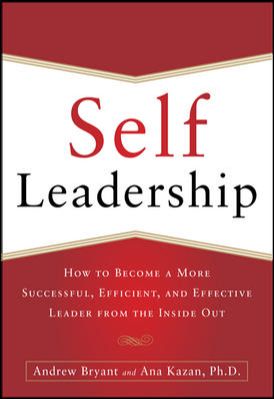
The practice of intentionally influencing your thinking, feelings, and actions toward your objectives (Bryant & Kazan, 2012) makes each IGNITE element possible. You cannot inspire others from a place of confusion about your own purpose. You cannot guide effectively without the self-awareness to know your own blind spots. You cannot nurture belonging if you cannot regulate your own emotional state under pressure. You cannot integrate new practices without the self-discipline to sustain them beyond the initial motivation. You cannot transform without the self-learning that converts experience into growth. You cannot evaluate honestly without the self-awareness to accept what the data is telling you.
Self-leadership is the inner architecture. IGNITE is the outer expression.
This is also what makes the IGNITE Framework different from other transformation methodologies. Most frameworks assume that people are ready to change — that if you give them the right tools and the right environment, behavior will follow. Self-leadership research across 40 years and more than 200 peer-reviewed studies shows that is not how it works. Sustainable behavior change begins with self-influence: the capacity to direct your own thinking and feeling before you attempt to direct anything external.
IGNITE is a self-leadership framework applied to the challenge of organizational transformation.

Leadership Impact
"Andrew Bryant enabled us to transform our organization into a holistic, high-performing team. His self-leadership approach helped us to understand ourselves as individuals, leaders, and our roles in the team."
— Marek Dziki, MD, PhD, MBA
Who is the IGNITE Framework For?
The IGNITE Framework applies at two levels, and the research from organizations that have implemented it most effectively shows it works best when both levels are addressed simultaneously.
For individual leaders
IGNITE provides a personal development roadmap: a sequence of capabilities that build on each other, from the clarity of purpose that drives Inspire through the continuous learning discipline of Evaluate. Executive coaching with Andrew Bryant is structured around the IGNITE elements, adapted to the specific development needs and organizational context of each leader.
For organizations
IGNITE provides a leadership development architecture: a framework for designing programs, measuring outcomes, and sustaining change beyond the workshop. It applies to high-potential development programs, executive team transformation, culture change initiatives, and the specific challenge of leading through AI adoption.
The common thread, whether working with an individual leader or an enterprise program, is that IGNITE starts from the inside: with the mindset, the identity, and the self-leadership that make everything else possible.
How the IGNITE Framework Is Delivered
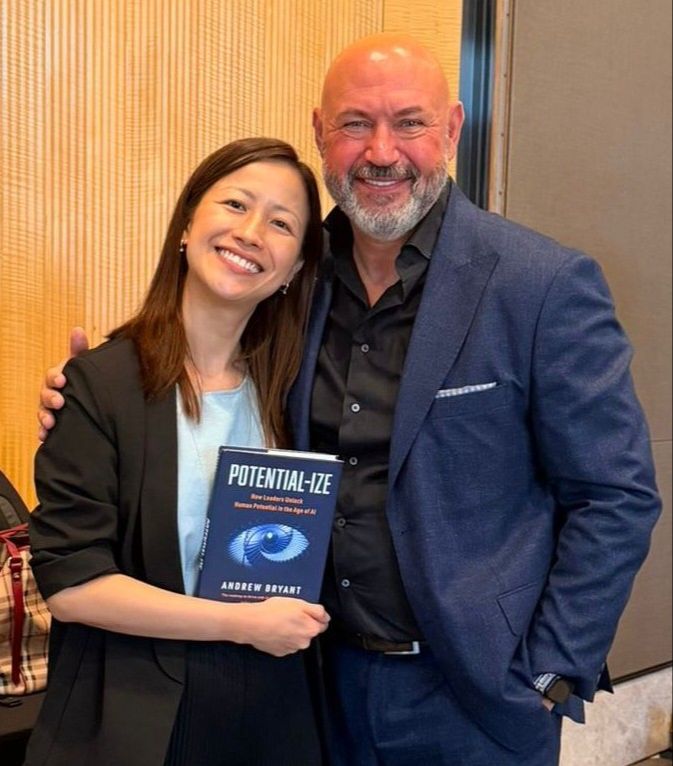
POTENTIAL-IZE: The Book The IGNITE Framework is introduced and explained in full in POTENTIAL-IZE: How Leaders Unlock Human Potential in the Age of AI (Wiley, 2026). With insights, stories, case studies, and implementation guidance across each element, it is the definitive resource for leaders who want to apply the framework to their own development and their organizations
Get POTENTIAL-IZE the Book →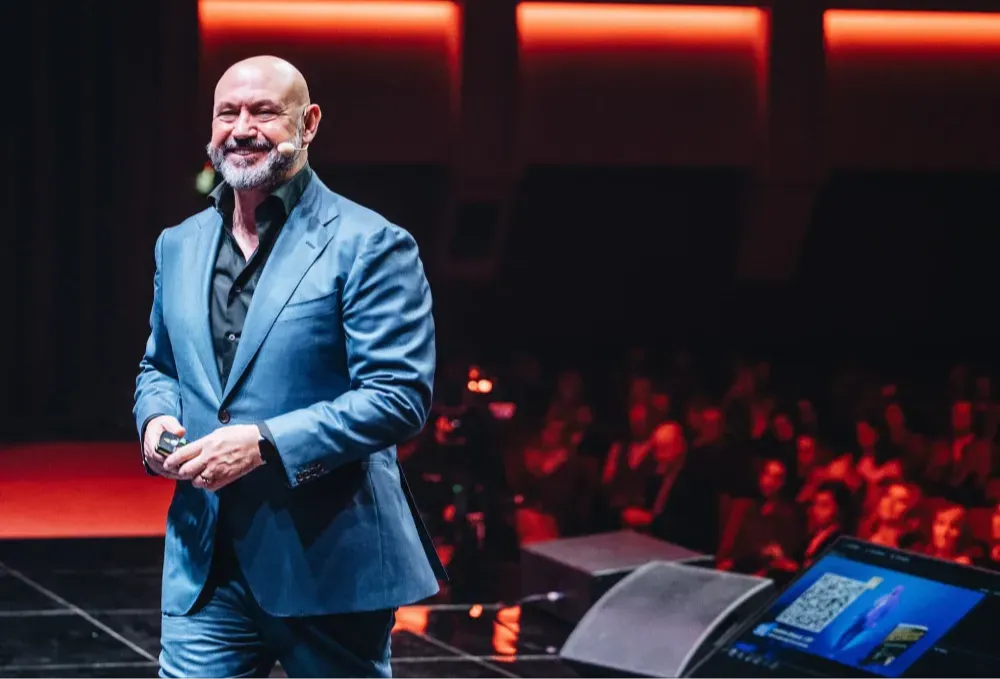
The IGNITE Keynote Building High-Potential Teams in the Age of AI
Andrew delivers the IGNITE Framework from the stage as a keynote tailored to the specific challenges and context of each organization. The session is built around the moments that shift thinking — reinforced with evidence, made practical through tools, and designed to sustain behavior change beyond the event. Available as a standalone keynote, a half-day masterclass, or as part of a broader leadership program.
Executive Coaching
For leaders who want to work through the IGNITE elements with direct coaching support, Andrew's executive coaching engagements are structured around the framework: diagnostic assessment, personalized development across the six elements, optional psychometric profiling, and accountability between sessions.
Leadership Workshops and Masterclasses
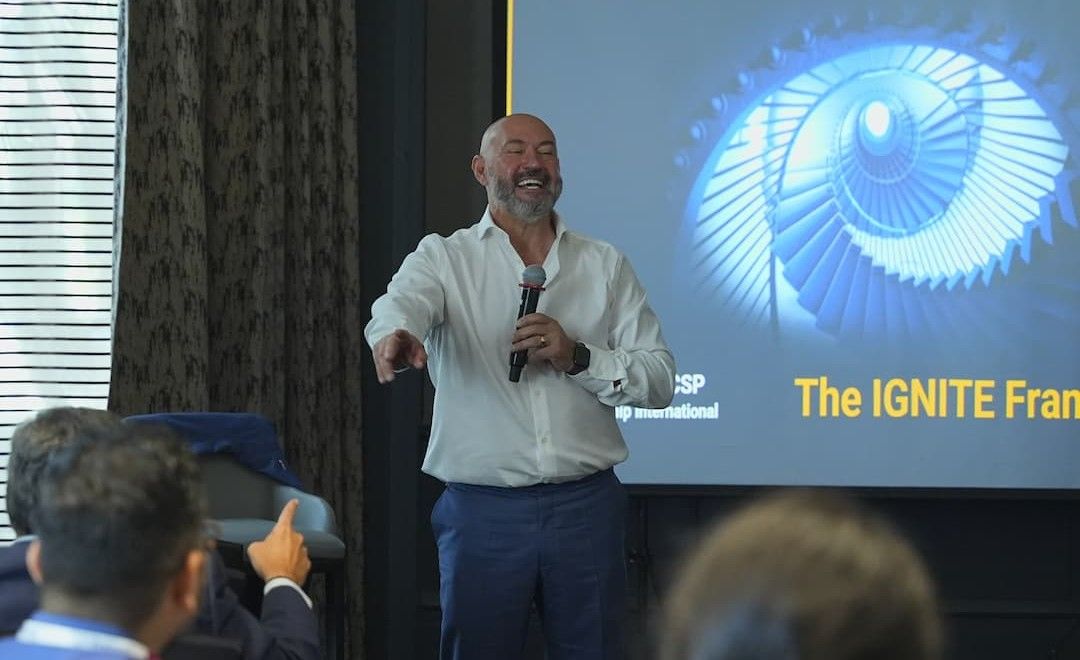
From three hours to three days, Andrew delivers IGNITE-based workshops for leadership teams, high-potential cohorts, and culture change initiatives. Every program addresses both individual self-leadership and collective team performance.
The Researcher Behind the IGNITE Framework
The IGNITE Framework is not a consultant's model assembled from best practices. It is the product of 25 years of research, clinical observation, and field-tested practice across 40+ countries.
Andrew Bryant began his career as a physiotherapist working with elite athletes. He learned early that the difference between good and great performance is almost never physical. It is the quality of the inner game: the thinking, the belief, the ability to regulate under pressure and recover from setbacks. He carried that insight into leadership development, trained across psychology, neuro-linguistics, neurosemantics, and acupuncture, and founded Self Leadership International in 1999.
His academic text, Self Leadership (Bryant & Kazan, McGraw-Hill, 2012), has been cited in over 200 peer-reviewed papers. POTENTIAL-IZE (Wiley, 2026) brings 25 years of that research forward into the AI era. He holds the Certified Speaking Professional (CSP) designation and has spoken for organizations including Microsoft, Singapore Airlines, Airbus, Deloitte, and Credit Suisse.
The IGNITE Framework is the synthesis of all of it: the clinical precision of a diagnostician, the academic rigor of a researcher, and the practical edge of someone who has been in the room with leaders navigating the hardest moments of their careers for a quarter of a century.
IGNITE is the full framework. For the more immediate, practical starting point, see how to become a better leader.
Human Potential in the Age of AIQuestions About the IGNITE Framework
How is IGNITE different from other transformation frameworks?
Where was IGNITE developed?
Can the IGNITE Framework be applied to an entire organization, or just individual leaders?
How do I start working with the IGNITE Framework?
The gap between knowing and doing is where leadership fails. IGNITE closes it.
If you are ready to stop being overlooked and start being trusted with what you are actually capable of, the work begins here.
Get your copy of POTENTIAL-IZE →