
Executive Presence
The Ability to Command a Room, Earn Trust, and Lead with Authority, Even When You Don't Have All the Answers
Explore the Executive Presence Masterclass →Most leaders are more capable than they appear.
That gap is costing them.
There is a moment most ambitious leaders recognize. You are in the room. You have the knowledge, the track record, the ideas. But something is off. Someone else is doing the talking. Someone else is getting the credit. And somehow, someone else got promoted.
It is not a performance problem. It is a presence problem.
Executive presence is the invisible factor in every leadership conversation. It shapes how seriously you are taken before you open your mouth. It determines whether your ideas gain traction or disappear into the ether. It is what makes the difference between being competent and being credible — between being heard and being trusted.
Here is what most people get wrong: they believe presence is something you either have or you don't. A personality trait. A gift. Something reserved for the extroverts and the naturals.
That belief is wrong. And it is expensive.
Executive presence is a learnable set of competencies, grounded in self-leadership, that any disciplined professional can develop. I have watched it transform careers — not over years, but over months.
The Definition of Executive Presence

Executive presence is the ability to project confidence, gravitas, and composure under pressure, in a way that causes others to trust your judgment and follow your lead.
Notice what that definition does not include: height, an impressive title, a loud voice, or an extroverted personality. None of those things are executive presence. They are frequently confused with it, which is how so many technically brilliant people end up being overlooked, and why so many mediocre performers end up in rooms they arguably should not be in.
Genuine executive presence has three dimensions:
Credibility — People believe you know what you are talking about, and that you have earned the right to say it. This is built through expertise, consistency, and the way you handle being wrong.
Composure — You remain grounded under pressure. When the room gets difficult, when the question is hard, when the stakes are high, you do not contract. You expand. This is not calmness for its own sake — it is the signal that you are safe to follow into uncertainty.
Influence Capital — You can move people. Not through positional authority or force, but through the ability to understand what others value, communicate in a language that reaches them, and create alignment around a shared direction.
These three dimensions are learnable. But they are not built through presentation skills courses or by studying how other people dress. They are built from the inside out — through self-leadership.
The three dimensions Credibility, Composure, and Influence Capital also determine how each member of an Executive Leadership Team shows up for their peers, not just for their own teams. Presence at the ELT level is as much collective as it is individual.
Learning Executive Presence from an Experienced Coach
Explore Coaching for Executive Presence →










In 25+ years of coaching executives, I have diagnosed hundreds of presence problems. The presenting complaint is usually external: "I need to communicate better." "I need to be more visible." "I need to stop being overlooked in meetings."
But the root cause is almost always internal.
The leader who cannot project confidence has a self-confidence problem, not a speaking problem. The leader who shrinks under pressure has not yet developed self-regulation. The leader who fails to influence others cannot yet read what people actually value, which is a self-awareness gap.
There's a reason self-awareness and executive presence are this tightly linked: research shows that self-understanding and understanding other people share overlapping brain circuitry in the medial prefrontal cortex. Reading a room isn't a separate skill from knowing yourself; it draws on the same underlying system. That's the deeper mechanism behind why leaders who misjudge a room are so often the same leaders who misjudge their own reactions under pressure. I go deeper on this research in The Neuroscience of Self-Awareness, and it's the foundation of my Executive Presence keynote speech.
This is why I have never found a shortcut to executive presence that lasts. Techniques without a foundation collapse under pressure. The executive who learns to "perform" confidence without developing genuine self-belief will fall apart in the meeting that really counts.
The durable path to executive presence runs through self-leadership — the practice of intentionally influencing your thinking, feeling, and actions toward your objectives (Bryant & Kazan, 2012).
Specifically, three self-leadership competencies underpin executive presence:
Self-Awareness is the foundation. You cannot change what you cannot see. Most leaders have blind spots about how they are perceived — the nervous habits that undermine authority, the defensiveness that erodes trust, the patterns they repeat under stress. Self-awareness is the diagnostic layer. Without it, everything else is guesswork.
Self-Regulation is what others experience as composure. The ability to modulate your emotional state — not suppress it, but direct it — is what allows you to remain clear-headed when the room is difficult, make good decisions under pressure, and signal to others that you are a stable point in an unstable situation. That signal is leadership.
Self-Learning is what keeps presence current and adaptive. The environment changes. New stakeholders arrive. Industries transform. Leaders who stop learning stop growing, and when they stop growing, their presence stagnates. The most compelling executives I have worked with are, without exception, people who are genuinely curious and deliberately developing.
When these three competencies operate together, executive presence stops being a performance and starts being an identity. That is the point at which it becomes durable.
What Happens When Executives Develop Presence?
"Before being coached on Executive Presence, I was a Lead Technology Architect being overlooked for advancement. Applying the coaching insights — without expensive degrees, just practical and actionable advice — I achieved my goal. I am now the Director of Global Technology for a rapidly expanding company."
— Daniel, Director of Global Technology

Two Ways to Develop Your Executive Presence
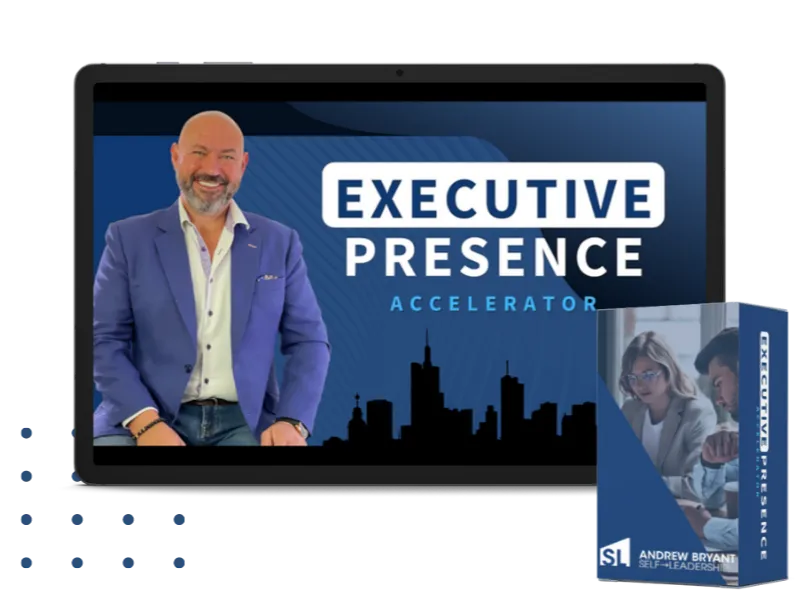
The Executive Presence Accelerator
A six-module online program built on the strategies above, designed to stop you from being overlooked and start your journey to senior leadership. Practical, self-paced, and built from 25 years of coaching real executives in real organizations.
1:1 Executive Coaching with Andrew Bryant
For leaders who want to go directly to the source. Andrew's coaching is diagnostic, individualized, and grounded in the complete self-leadership methodology. With optional psychometric profiling, a clear development plan, and direct access between sessions.
Real outcomes from real people

"Before the program, I was a program manager in the Healthcare Unit of a software company. After working with Andrew, I received three back-to-back promotions. I am now Head of Delivery, Enterprise Apps Group."
— Anjali, Head of Delivery
Clearing Up the Myths
It is not charisma. Charisma is magnetic. Executive presence is trustworthy. The two can coexist, but presence without charisma is far more valuable than charisma without presence. Many of the most effective leaders I have coached would not be described as naturally charismatic. They are, however, deeply trusted.
It is not about being the loudest voice. Leaders who equate visibility with volume create noise, not presence. The executive who asks the question no one else thought to ask, in a quiet and confident way, has more presence than the one who fills the room with words.
It is not reserved for senior leaders. Presence is relevant from the first moment you enter a room with influence at stake — which, for most professionals, is fairly early in their careers. The sooner you develop it, the more compounding returns you will see.
It is not a fixed trait. This is the most damaging myth. I have watched people in their forties and fifties completely transform how they show up. Presence is a practice. Like any practice, it responds to attention, discipline, and good coaching.

Presence Is Not Enough: You Also Need Influence Capital
Here is something I see missed in almost every conversation about executive presence: presence gets you in the room. What keeps you there is influence.
I use the term Influence Capital deliberately. Like financial capital, influence is something you build over time, through consistent deposits — credible decisions, honest communication, delivered commitments — and something you spend when you need people to move.
The leaders who have developed executive presence but not Influence Capital are the ones who seem authoritative in meetings but cannot get things done across functions. They are taken seriously but not followed.
Influence Capital is built through three behaviors:
Alignment — understanding what others value and framing your message around it. Not manipulation. Translation.
Reciprocity — showing genuine interest in others' success, not just your own. The most influential leaders I know are also the most generous with their attention and their networks.
Integrity — doing what you said you would do. Nothing erodes Influence Capital faster than a broken commitment. Nothing builds it faster than a kept one, especially when it was inconvenient.
When executive presence and Influence Capital work together, the effect is not just personal advancement. It is organizational movement. That is when leaders stop managing and start actually leading.
Six Strategies to Build Your Executive Presence
Explore the Executive Presence Accelerator →These are the strategies I have used with hundreds of executives across five continents. They are sequenced deliberately — the early ones create the foundation for the later ones.
Strategy 1: Reframe Your Narrative The most powerful thing limiting your executive presence is probably not your communication style or your gravitas — it is the story you are telling yourself about who you are and what you are capable of. Impostor syndrome, self-limiting beliefs, and the fear of being found out are presence problems before they are performance problems. The first step is examining the frame and choosing a more accurate and more useful one.
Strategy 2: Build Unshakeable Confidence Confidence is not the absence of doubt — it is the decision to act in spite of it. I use what I call the Vessel of Confidence with coaching clients: a framework for connecting to genuine sources of self-belief rather than trying to manufacture confidence from the outside in. The executives who carry themselves with natural authority are not doubt-free. They have simply built a relationship with their competence that doubt cannot easily destabilize.
Strategy 3: Develop Authentic Influence Influence that is not grounded in your values will always feel forced, to you and to others. The most effective influence strategy I know starts with clarity about what you stand for, combined with genuine curiosity about what others value. When those two things meet in a conversation, you do not need to "be persuasive." You already are.
Strategy 4: Lead with a Winner's Mindset A winner's mindset is not about winning at others' expense. It is about refusing to accept less than the full value of what you and your team are capable of. This strategy addresses the habits that undermine performance: scarcity thinking, procrastination disguised as preparation, and the tendency to over-qualify your ideas in the very moment you need to land them cleanly.
Strategy 5: Claim Your Presence This is where the internal work becomes visible. The posture, the pace, the way you use silence, how you respond to challenge — these are not superficial styling choices. They are the physical language of the leader you have become. When the inner work is done, these behaviors follow naturally. When they are taught without the inner work, they are a costume.
Strategy 6: Operate at C-Suite Level The final strategy is about standards — the standard of thinking, of conversation, of preparation, and of behavior that the most effective senior leaders hold themselves to. This is not about impressing boards. It is about operating from a philosophy of excellence that does not depend on external validation, because that is the level at which real leadership happens.
The Self-Leadership and Executive Presence Expert
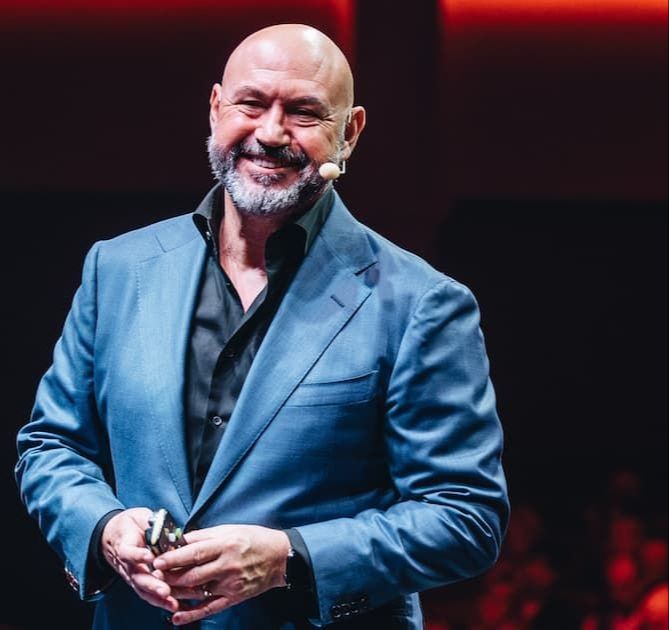
Andrew Bryant, CSP, is the founder of Self Leadership International. He began his career as a physiotherapist working with elite athletes, where he learned that the difference between good and great performance is almost never physical; it is mental. The same is true in leadership.
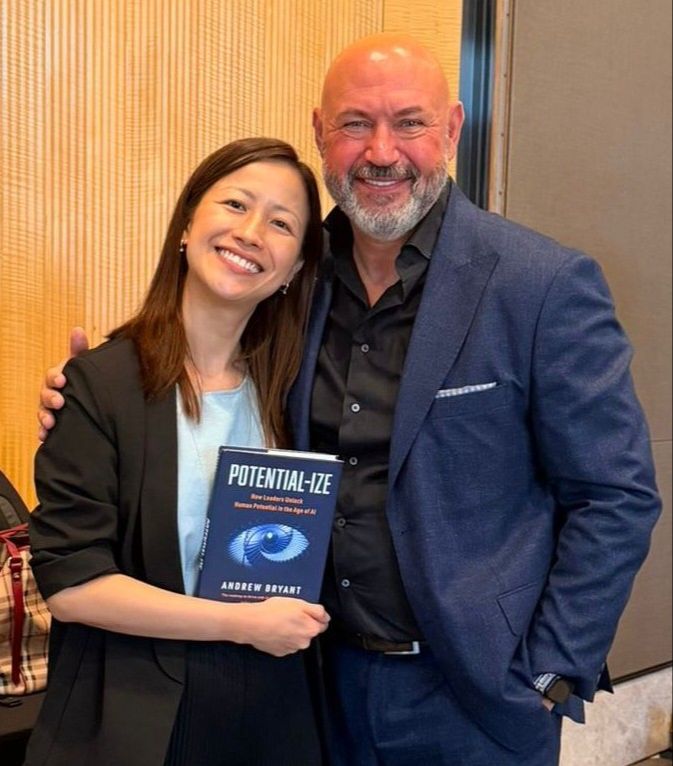
He has spent the past 25 years working with executives from Microsoft, Singapore Airlines, Airbus, Deloitte, and hundreds of other organizations across more than 40 countries. Andrew Bryant is the practitioner behind the definition of self-leadership in Self Leadership (McGraw-Hill, 2012), a definition cited in peer-reviewed research and used in learning resources published by Penn State and NHS Education for Scotland. My latest book, POTENTIAL-IZE: How Leaders Unlock Human Potential in the Age of AI (Wiley, 2026), sets the agenda for human performance in the age of AI.
He holds the Certified Speaking Professional (CSP) designation, positioning him at the top of the field.
Andrew's coaching on executive presence is not theoretical. It is diagnostic. He does not prescribe before he understands the specific gap, and he doesn't offer generic techniques when the real issue runs deeper. That background in physiotherapy and performance science fuels the approach: prescription without diagnosis is malpractice.
Executive presence is one piece of a broader picture. For the fuller view of what separates leaders who develop from those who plateau, see how to become a better leader.
"Before coaching, I was a Senior Manager overseeing 2,000 security staff, and I knew I needed to step up. Following the program, I moved to a new company as Head of Strategy and Operations." — Nick, Head of Strategy and Operations

Questions About Executive Presence
The questions leaders ask me most often, answered directly.
Can executive presence actually be learned?
Yes. It is one of the most persistent and damaging myths in leadership development that presence is a personality trait, something you have, or you don't.
It's a set of learnable competencies. I have coached people in their forties and fifties who transformed how they show up in high-stakes situations within months.
How long does it take to develop executive presence?
Most people begin noticing meaningful shifts within weeks of deliberate practice, changes in how they handle pressure, how they communicate in difficult meetings, and how they respond rather than react.
Deeper shifts, the kind that hold up in genuinely high-stakes environments, typically compound over three to six months.
What is the difference between confidence and executive presence?
Confidence is internal; the belief that you are capable. Executive presence is how that confidence is expressed outward in a way that others can observe and trust. You need both.
The most common mistake I see is people trying to project presence without having developed the inner foundation of genuine self-belief. It does not hold.
Is executive presence the same as charisma?
No. Charisma is magnetic, it draws people in. Executive presence is trustworthy, it causes people to follow. Some leaders have both. Many excellent leaders have a strong presence and limited charisma.
The reverse, high charisma and low presence, tends to create short-term impact and long-term credibility problems.
How does self-leadership relate to executive presence?
Self-leadership is the foundation. Executive presence is the outward expression of it.
When leaders develop self-awareness, self-regulation, and self-learning, the three core self-leadership competencies, executive presence follows naturally. Without that foundation, presence is a performance, and performances eventually collapse under pressure.
What are some quick, practical ways to project executive presence in a meeting?
The habits are smaller than people expect. Stand or sit tall, even on a call where no one can see you; people feel confidence before they hear it.
Trade hedging language ("I'll try", "maybe") for direct language ("I think", "I believe").
Let a point land before rushing to the next one; a pause reads as considered, not uncertain. And when you're delivering an update, lead with the headline rather than the build-up.
None of these are performance tricks. They work because they're outward signals of the self-regulation and self-awareness that real executive presence is built on, which is why they only hold up once the inner work is in place.
What's the neuroscience behind executive presence?
Self-awareness and reading a room share overlapping circuitry in the medial prefrontal cortex. They are not two separate skills sitting in two separate places.
That is why the two problems I see most often, losing composure under pressure and misreading a room, so often trace back to the same underlying self-awareness gap rather than to two different development needs. Working on one tends to move the other. Read the research →
Does Andrew Bryant speak on executive presence?
Yes. Executive Presence: Influence Without Authority is one of my seven keynote topics, available as either a keynote or a workshop.
It covers building credibility, commanding a room, and leading across cultures where authority and hierarchy operate differently, and it treats presence as a behavioral and communication discipline grounded in the neuroscience above rather than as a style exercise.
If you are looking for an executive presence speaker for a leadership summit, an offsite, or an internal conference, the full topic list and booking details are on the keynote speaking page →
Still deciding whether this is a coaching conversation or a keynote? Tell me about your situation → and I will point you to whichever one actually fits.
Self-leadership is the foundation. Executive presence is the result.
If you are ready to stop being overlooked and start being trusted with what you are actually capable of, the work begins here.
Explore the Executive Presence Accelerator →