
Self‑Leadership for Entrepreneurs: Lead Yourself First, Then Your Business
Aug 18, 2026
Most founders don't fail because they lack a strategy. They fail because they can't consistently lead the one person who determines whether the strategy gets executed: themselves.
This article is for entrepreneurs who are strong externally (sales, product, team) but often feel internally scattered, reactive, or exhausted. It outlines what self-leadership means in practice for business owners, the core capabilities you need, and how to build a simple, repeatable practice that scales with your company.
For the foundational models behind everything here, see What is self-leadership, and Leading in The Age of AI.
What "self-leadership for entrepreneurs" actually means
Self-leadership is the ability to intentionally direct your own thoughts, emotions, and actions toward what matters most, especially when no one is watching.
For entrepreneurs, that shows up as:
- Keeping promises to yourself (sleep, health, focus time) even when the business is on fire
- Choosing responses instead of reacting from stress, fear, or ego
- Aligning daily choices with your values and long-term vision, not just short-term revenue
- Building systems that protect your energy, attention, and integrity
If you've been searching for "self leadership for entrepreneurs," you likely already sense the gap: you can run a company, but you struggle to run your own inner world with the same discipline and clarity.
Why entrepreneurs need self-leadership more than anyone else
Founders face pressures most employees never encounter:
- You are the final authority: There's no boss to override your worst impulses.
- Your state is strategic: Your anxiety, clarity, or reactivity becomes company culture.
- Your decisions compound: One emotionally driven hire, price cut, or pivot can cost years.
- Your identity is tied to outcomes: Business setbacks feel like personal failure.
In this context, self-leadership is not "soft." It's a strategic capability that determines:
- How well you make decisions in uncertainty
- How sustainably you perform over years, not just sprints
- Whether your business amplifies your strengths or magnifies your blind spots
That's why, as a leadership speaker for entrepreneurs, I frame self-leadership as the foundation for all other leadership work, especially in an era of AI and constant disruption.
The 7 self-leadership capabilities every entrepreneur should develop
Think of these as interlocking skills, not a checklist you must perfect before moving on. Pick one, practice it for 30 days, then layer in the next. This is the same underlying logic behind why habit systems only really work once the direction is right first; I go deeper on that specific relationship in Why Atomic Habits Works Better When You Lead Yourself First.
1. Self-awareness: seeing your patterns clearly
Self-awareness is the ability to observe your internal experience: thoughts, emotions, and inner narratives. Read Self-Awareness at Work: The Leadership Skill You Think You Have (But Probably Don't).
For entrepreneurs, self-awareness means noticing:
- When you're overcommitting to please others
- When you're avoiding a hard conversation or decision
- How your mood shifts the tone of meetings and Slack channels
Practice: the 3-question daily check-in
At the end of each workday, ask:
- What drained me today?
- What energized me today?
- Where did I act against my own best judgment?
Write one sentence for each. After two weeks, review for patterns. This is your personal "founder dashboard."
2. Self-regulation: choosing your response
Self-regulation is the capacity to feel your emotions fully without letting them hijack your decisions. Read Why Willpower Isn't the Answer to Self-Regulation.
Founders who regulate well:
- Don't send angry emails or make snap strategic moves after a bad call
- Can sit with uncertainty without forcing premature closure
- Stay present with their team instead of withdrawing or lashing out
Practice: the 90-second reset
When you feel triggered:
- Name the emotion ("I'm feeling threatened," "I'm feeling embarrassed").
- Breathe slowly for 90 seconds (in through the nose, out through the mouth).
- Ask: "What's the most constructive next step?"
This tiny pause creates space between stimulus and response, where leadership lives.
3. Ownership: treating every outcome as data
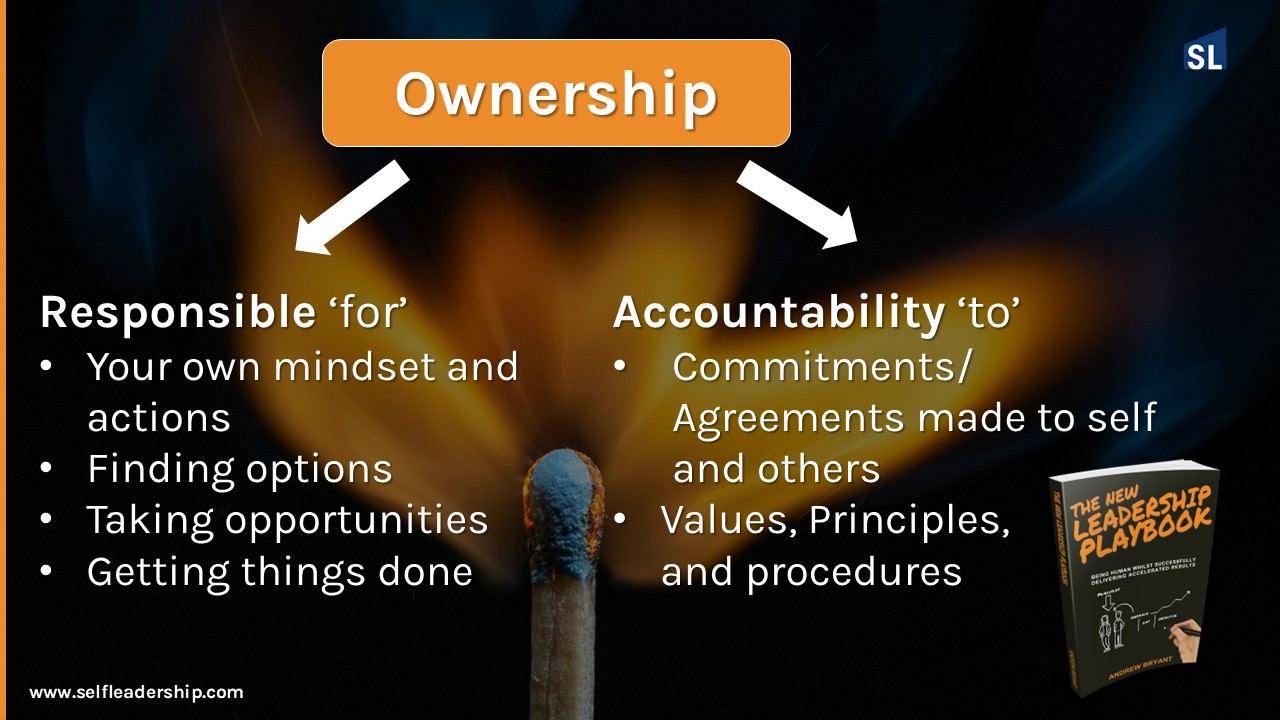
Ownership is the stance that whatever happens in your business, you have a part in it, and therefore a role in shaping what happens next.
This is different from self-blame. It's not "everything is my fault." It's "I always have some influence, so I always have some agency." Much of this comes down to the internal story you're telling yourself about what happened; I unpack that specific mechanism in The Story You Tell About Yourself Is Running Your Leadership.
Ownership is a function of self-regulation and self-learning, two of the three drivers in the self-leadership model.
Practice: the ownership reframe
When something goes wrong, replace:
- "They messed this up" → "What did I enable or overlook?"
- "I had no choice" → "What choice did I make, even passively?"
- "This always happens to me" → "What pattern am I repeating?"
This shifts you from the passenger to the driver of your business and life.
4. Energy design: building a business around your biology
Energy design is the practice of structuring your work, rest, and relationships so they support, not deplete, your capacity.
Most founders manage time; few manage energy. But you can't execute strategy when you're chronically exhausted. Read Living Your Best Life - Secrets to Body Hacking with Self-Leadership.
Practice: map your energy, then schedule around it
For one week, rate your energy (1-10) every 90 minutes. Note:
- What you were doing
- Who you were with
- What you had eaten / how you'd slept
Then:
- Protect your highest-energy windows for your most important work (strategy, key conversations, creation).
- Batch low-energy tasks (admin, routine calls) into your natural dips.
- Treat recovery (sleep, movement, relationships) as non-negotiable infrastructure, not a reward.
5. Values-based decisions: reducing decision fatigue
Values-based decision-making uses your core principles as filters, so you don't have to re-debate every choice from scratch.
When your values are clear, decisions become faster and more aligned. Read Personal Mastery: Definition, Origin, and How to Develop It.
Practice: define your top 5 and use them as a filter
- List 10 values that matter to you (e.g., freedom, integrity, family, impact, growth).
- Force-rank them: which would you sacrifice for which?
- Choose your top 5 non-negotiables.
- For each, write one sentence on what it looks like in action in your business.
Before major decisions, ask:
- Does this align with my top 5?
- Will future-me thank present-me for this?
- Am I deciding out of fear or from vision?
6. Focused execution: doing less, better
Focused execution is the ability to identify the few activities that truly move your business forward and protect uninterrupted time for them.
Most founders are busy; few are consistently effective. Read Executive Function: The Hidden Engine Behind Leadership Performance.
Practice: the "one thing" rule
Each day, ask:
- If I could only accomplish one thing today, what would make everything else easier or unnecessary?
Then:
- Schedule a 90-minute block for that one thing during your peak energy window.
- Turn off notifications and close all unrelated tabs/apps.
- Treat this block as a meeting with your most important client: your future self.
7. Continuous growth: treating yourself as a work in progress
Continuous growth is the commitment to keep learning, adapting, and expanding your capacity as your business evolves.
Your company will hit ceilings that are actually your own ceilings: skill, mindset, emotional range. Growth is how you remove them. As AI takes on more of the tasks that used to define seniority, I argue in POTENTIAL-IZE (Wiley,2026) that the capacity to keep growing yourself is becoming the real differentiator for founders, not another tool or hire.
Practice: the weekly learning hour
Once a week, block 60 minutes for:
- Reading a chapter of a relevant book
- Reviewing a key win and loss from the week
- Identifying one skill to improve in the next 7 days
- Writing down one insight you'll apply immediately
Over a year, that's 52 hours of deliberate development, enough to materially shift your trajectory.
Self-leadership vs coaching: do entrepreneurs need both?
A common question: "Do I need self-leadership skills, a business coach, or an executive coach?"
- Self-leadership is the internal capability you build and practice daily.
- Coaching is external support that accelerates insight, accountability, and behavior change.
They're not either/or. Self-leadership makes coaching more effective; coaching, in turn, accelerates self-leadership. The most successful founders develop both. Explore coaching.
Are You Part of an Entrepreneur Organization?
If you are part of an organization, I can share these and other insights as a keynote speech for entrepreneurs; feel free to contact me.
Frequently Asked Questions
How long does it take to develop self-leadership as an entrepreneur?
Most founders notice meaningful change within 30 days of consistent practice. Deeper mastery typically develops over 6-12 months. The key is regular, small practices, not perfection.
Which self-leadership skill should I start with?
Start with self-awareness. You can't change what you can't see. Once you understand your patterns, other skills (emotional regulation, focus, ownership) become much easier to develop.
Can self-leadership be learned, or is it innate?
Self-leadership is learnable. Like any capability, it improves with deliberate practice. Natural tendencies help, but consistent habits matter more over time.
How do I maintain self-leadership under extreme stress?
Pre-plan your responses: use short regulation practices (like the 90-second reset), protect recovery time, and rely on accountability structures you set up in calmer periods. Your systems carry you when willpower can't.
What's the relationship between self-leadership and business success?
Your business can only grow to the extent that you do. Self-leadership improves decision quality, execution consistency, and sustainable energy, directly impacting long-term performance.
Is self-leadership the same as self-discipline?
No. Self-discipline is about forcing action. Self-leadership is broader: it includes awareness, emotional regulation, values alignment, energy management, and growth. Discipline is one component; self-leadership is the system.
How does self-leadership relate to therapy or coaching?
- Therapy often focuses on healing and mental health.
- Coaching focuses on goals, behavior change, and performance.
- Self-leadership is the internal capability you use to lead your own thoughts, emotions, and actions day-to-day.
They're complementary; strong self-leadership makes both therapy and coaching more effective.
Turn Insight Into ActionReading about leadership can change what you know.Self-leadership changes what you do.Develop your leadership effectiveness → Explore Self-leadership Discover your leadership strengths & gaps → Choose an Executive Coach Unlock the potential of your team → Workshops & Masterclasses Ignite your event or conference → Book Andrew Bryant as your Leadership Speaker "Prescription without diagnosis is malpractice" |