
Human Potential in the Age of AI
"The greatest leadership challenge of our time is not AI; it's the failure to invest in human capabilities."
- Andrew Bryant
Last updated: August 23, 2026
Human potential in the age of AI is the capacity of individuals and organizations to develop the distinctly human capabilities, judgment, trust, adaptability, and ethical reasoning, that determine whether an AI investment produces results or just produces noise.
Andrew Bryant's research shows this capacity is built through self-leadership: the practice of intentionally influencing your own thinking, feeling, and actions toward your objectives (Bryant & Kazan, 2012). Accelerating human potential, not accelerating AI adoption, is what actually moves the numbers.
Every conversation about AI in the workplace eventually arrives at the same question: What will AI replace?
It is the wrong question.
It focuses attention on the technology and its capabilities at precisely the moment when organizations should be focused on the human beings who will decide whether that technology creates value or just creates noise. It treats the AI transition as something that is happening to people, rather than something that people will navigate or fail to navigate based on their own capabilities.
The right question is not what AI will replace. It is:
What do humans need to become?
That question has a specific, researchable, developable answer. And the leaders and organizations that find it early will have a meaningful advantage over those still asking the wrong one.
How Should Executives Adapt Their Leadership Style & Communication to Unlock Human Potential?
Something has been quietly happening in the language of organizations over the past decade. The words in job descriptions, leadership competency frameworks, and performance reviews have been changing.
The shift looks gradual on paper. In practice, it represents a fundamental rethinking of what leadership is for.
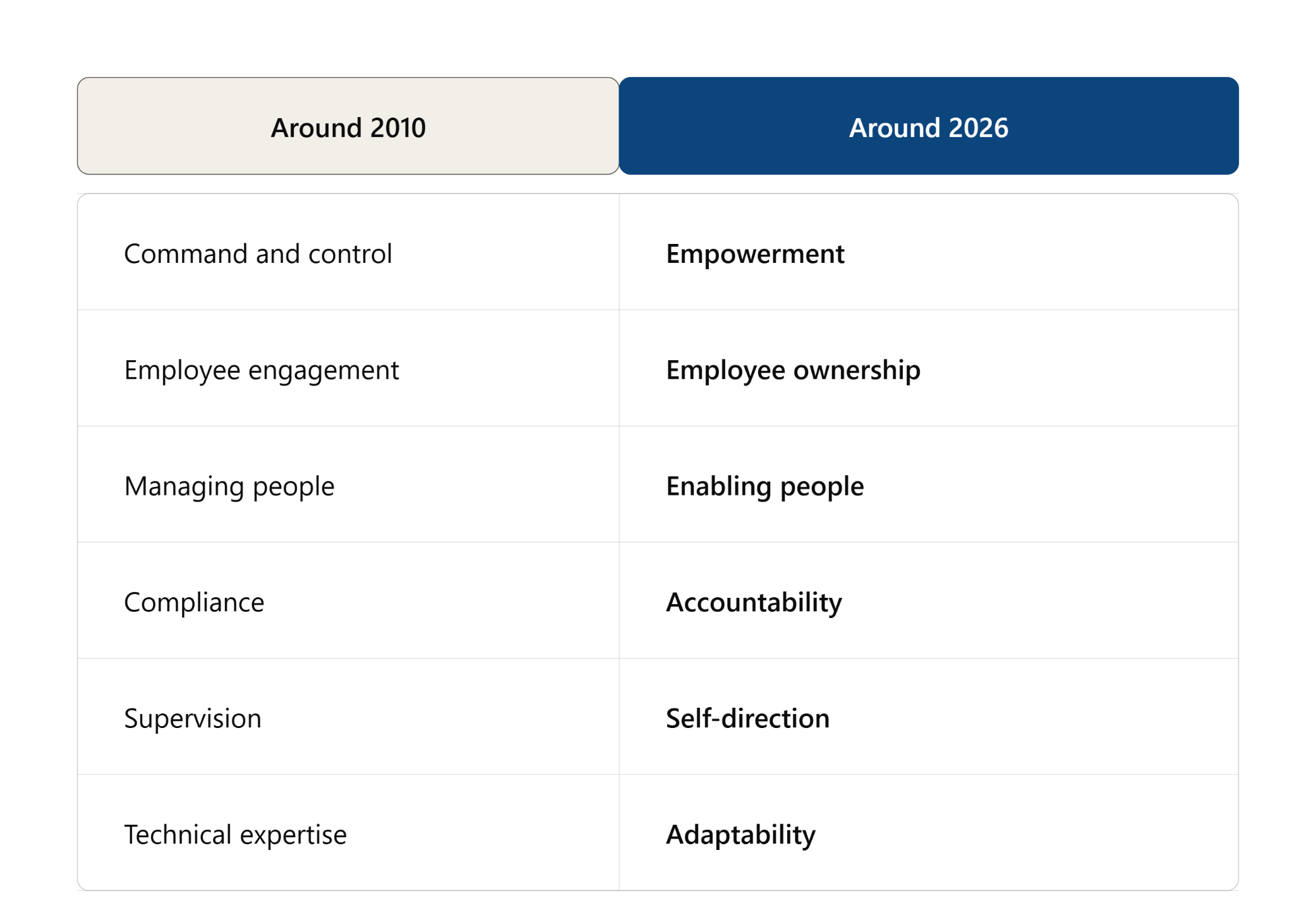
Look at the right column. Self-direction. Accountability. Empowerment. Ownership. Adaptability.
These are not new leadership buzzwords. They are the vocabulary of self-leadership - the practice of intentionally influencing your thinking, feeling, and actions toward your objectives (Bryant & Kazan, 2012).
Organizations have been asking for self-leadership capabilities without always using the term. AI has not created this demand. It has accelerated and intensified it to the point where organizations can no longer ignore it. As AI handles more of the routine cognitive work—the analysis, the summarizing, the pattern recognition, the first drafts—what remains for humans is precisely the work that self-leadership develops.
- Judgment
- Initiative
- Adaptability
- Ethical decision-making
- The ability to learn continuously
- The willingness to take accountability for outcomes
These are not soft skills. They are the capabilities that determine whether an organization's investment in AI yields results or results in expensive confusion.
Who Is the Right Speaker or Coach for Leading at the Intersection of Humans and AI?
MIT's NANDA research found that 95 percent of enterprise AI pilots deliver zero measurable financial impact, and the researchers traced most failures back to leadership, not the technology. Companies are not struggling to buy AI. They are struggling to lead through it.
Andrew Bryant works with organizations at exactly this junction, helping leaders and teams figure out which decisions still require human judgment and which can be handed to a machine, then building the self-leadership capacity to do that well under pressure.
His IGNITE framework provides leaders and teams with a repeatable process for adopting AI without sacrificing human capabilities or accountability.
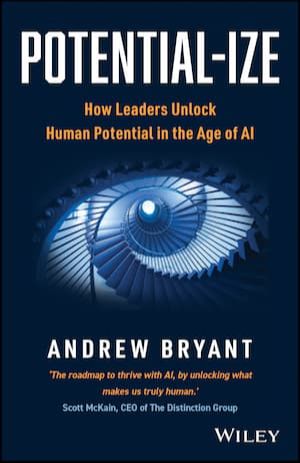
His keynote speeches and leadership development programs are not generic AI keynote content; they draw on Andrew's original research into human potential in POTENTIAL-IZE (Wiley, 2026) and more than two decades of coaching executives through change, applied specifically to the leadership judgment AI cannot replace.
Book a Strategy Call →Why Corporations are Realizing that Self-Leadership is the Key Leadership Competency in The AI Era
Self-leadership is not one leadership competency among many.
It is the operating system that makes every other leadership capability function. You cannot build genuine adaptability in a person who does not lead themselves. You cannot develop ethical judgment in a leader who is not self-aware. You cannot create authentic influence through someone who has not developed self-regulation.
The leadership behaviors that organizations are urgently trying to develop rest atop self-leadership. Without the foundation, everything built on it is unstable.
In his early career as a physiotherapist working with elite athletes, Andrew Bryant learned something that transfers directly to this work with leaders: prescription without diagnosis is malpractice. The reason most leadership interventions fail is not that the techniques are wrong.
It is that they treat the symptom rather than the system. Self-leadership is the system. In a world where AI can produce a strategic analysis faster than any analyst, a legal summary faster than most associates, and a first draft faster than most writers, the human value proposition shifts entirely to the capabilities that are not cognitive outputs. It shifts to the inner operating system - the self-awareness, the self-regulation, and the self-directed learning that determines how effectively a person uses every tool, human or artificial, available to them.
This is the argument at the center of his latest book, POTENTIAL-IZE: How Leaders Unlock Human Potential in the Age of AI (Wiley, 2026).
What Is Human Potential?
The Potential-ize Formula Explained
"If self-leadership is becoming the best version of yourself
- to Potential-ize, is to expand what best means."
Human potential is one of those phrases that sounds inspiring and means almost nothing without a framework.
In POTENTIAL-IZE, I define it precisely:
Potential = Capacity x Opportunity x Willingness
Each variable is meaningful on its own. Combined, they explain something that most talent development conversations miss entirely.
Capacity is what a person is capable of—their skills, knowledge, and cognitive and emotional resources. Most talent development focuses here. It is necessary but not sufficient.
Opportunity is whether the environment creates the conditions for that capacity to be expressed. A high-capacity person in a low-opportunity environment will underperform consistently. This is why culture, psychological safety, and organizational design are not optional features. They are determinants of output.
Willingness is the variable that development programs most consistently ignore. It is the self-leadership variable. A person can have the capacity and the opportunity and still choose, consciously or unconsciously, not to bring their full capability to the situation. Fear of failure. Imposter syndrome. Misaligned incentives. Identity beliefs that cap performance. Willingness addresses why people who can do something consistently don't.
This formula changes what "unlocking potential" means in practice. It is not just training. It is not just culture. It is the intersection of all three, and the leader's job is to operate on all three variables simultaneously, for themselves and for the people they lead.
POTENTIAL-IZE - The Book →What Human Capabilities Can AI Not Replace?
When people say "AI cannot replace human creativity" or "AI lacks empathy," they are gesturing at something real but leaving it underexplored. Here are the five capabilities, according to Andrew Bryant, that determine leadership effectiveness in AI-augmented environments, and why self-leadership is the foundation of each:
1. Judgment under uncertainty
AI systems are excellent at predicting within patterns they have seen. They struggle with genuinely novel situations, ethical edge cases, and decisions where the relevant data does not yet exist. Human judgment, the ability to make high-quality decisions with incomplete information, informed by values and experience, is not a cognitive output. It is a character output. It develops through the self-leadership practice of intentional reflection, values clarity, and accountability.
2. The ability to inspire trust
Trust between people does not come from competence alone. It comes from the perception of genuine intention that the other person is acting on your behalf as well as their own. AI can simulate this. It cannot mean it. Leaders who have developed authentic self-awareness, who are honest about their limitations and consistent in their values, build trust in ways that algorithms fundamentally cannot. This is not sentiment. Organizations with high trust significantly outperform those without it.
3. Learning agility
Not just the ability to learn, but the ability to learn fast, under pressure, in unfamiliar territory, and to transfer that learning into changed behavior. AI can acquire information at extraordinary speed. It cannot decide what to learn next based on a values-led sense of where it wants to go. Self-directed learning —identifying your own development needs, finding resources, and building accountability for growth—is a self-leadership strategy, not an AI capability.
4. Ethical reasoning in context
AI systems can be trained on ethical principles. They cannot weigh the competing obligations, relationships, and consequences at play in a specific human situation. They cannot feel the discomfort that signals a conflict of values. The leader who has developed self-awareness and the capacity for principled accountability is not following an algorithm. They are drawing on something AI cannot be trained to replicate: a developed moral identity.
5. The capacity to develop other people
The best leaders I have worked with do not just achieve results themselves. They create conditions where the people around them consistently access more of what they are capable of. This requires genuine empathy, the patience to let people learn through struggle, and the ability to read what someone needs in a given moment versus what they say they want. It requires coaching capability grounded in self-leadership. No AI is going to do this well in the way that matters most: in the room, in the moment, with real human stakes. These are not characteristics people are born with. They are developed. That is the point of this page. They are developed through the intentional practice of self-leadership.
Keynote Speaker on Leadership and AI →Emotional Intelligence & Growth Mindset are Household Terms - Self-Leadership is Next
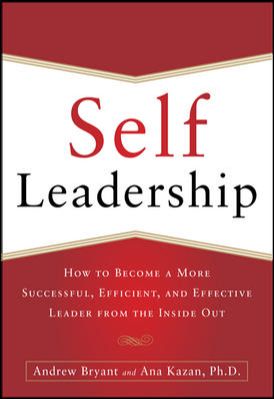
Self-leadership has a forty-year research history. Andrew Bryant is the practitioner behind the definition of self-leadership in Self Leadership (McGraw-Hill, 2012), a definition cited in peer-reviewed research and used in learning resources published by Penn State and NHS Education for Scotland. It has been validated across cultures from South Korea to South Africa. It is the conceptual foundation for the capability shifts that organizations are urgently trying to make right now.
And it is not yet a household business term.
Compare its recognition with Daniel Goleman's concept of emotional intelligence, Amy Edmondson's concept of psychological safety, Carol Dweck's growth mindset, or Simon Sinek's "Start With Why." Those frameworks have crossed into everyday organizational language. You hear them in boardrooms, performance reviews, and job advertisements. Self-leadership has not reached that level of recognition - yet.
There is a straightforward reason. Those frameworks were popularized at moments of strong cultural alignment between the idea and the organizational challenge of the time. Goleman arrived when businesses were beginning to understand that IQ alone did not predict leadership success. Edmondson's concept of psychological safety gained mainstream traction through Google's Project Aristotle, which showed how data-driven organizations could suddenly see the mechanism behind team performance. The right idea needs the right moment.
Self-leadership's moment is now.
The organizational challenge of this decade is not AI adoption. Organizations are getting reasonably good at adopting AI. The challenge is what AI adoption reveals: that most organizations have dramatically underinvested in the human capabilities that determine whether AI creates value or just creates throughput.
Self-direction. Accountability. Initiative. Adaptability. Continuous learning. These are self-leadership outputs. And organizations that cannot develop them are discovering that their AI investment is producing efficiency in the wrong places while the real bottleneck -- human judgment, trust, and leadership -- remains unaddressed.
The leaders and organizations that recognize this early will not just benefit from self-leadership. They will help establish it as the foundational leadership concept for the AI era. That is the opportunity.
The Self-leadership Certification Program →The IGNITE Framework: A Practical Model for Developing Human Potential
Understanding why human potential matters in the AI era is necessary. Knowing how to develop it systematically is what distinguishes insight from impact.
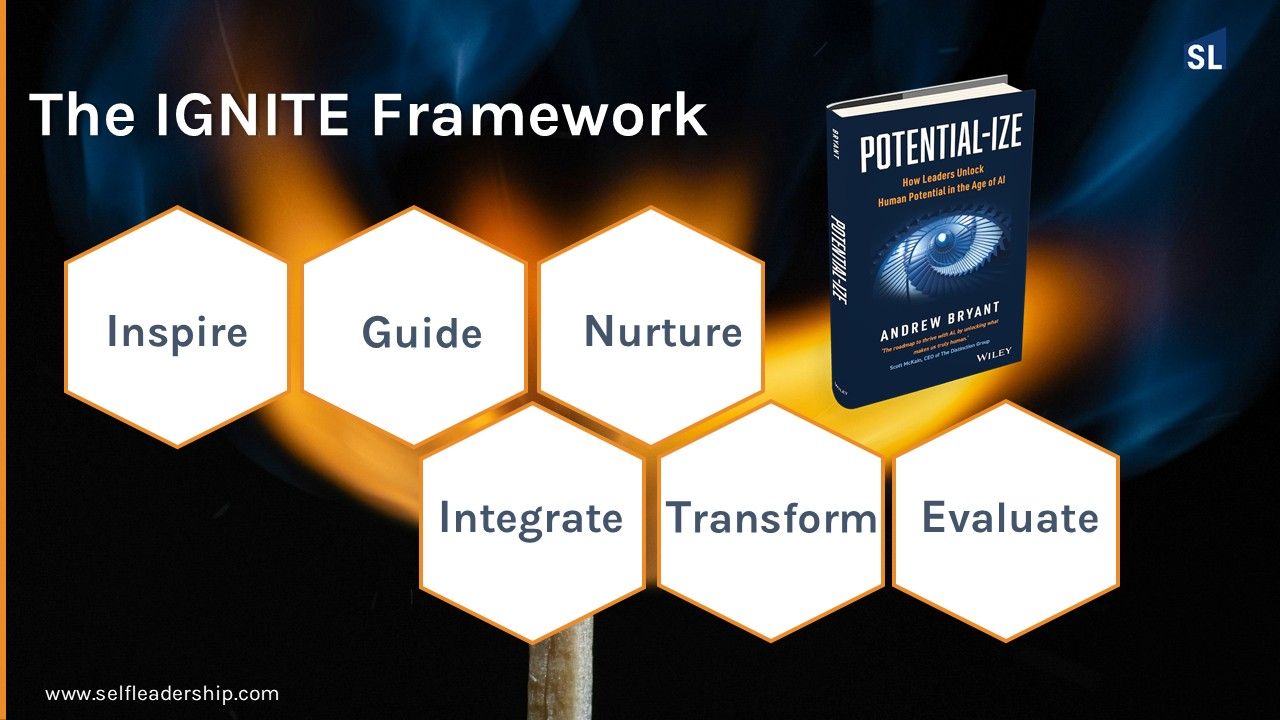
The IGNITE Framework is the methodology I developed across twenty-five years of self-leadership research and practice to do precisely that. It is a sequenced six-element system for systematic human development in organizations navigating transformation, uncertainty, and the demands of AI-augmented work.
It is not a competency model. It is not a checklist. Each element builds on the last, designed to close the gap between knowing and doing, and between intention and sustained behavior change.
The Six Elements:
Inspire: Create the meaning that makes change possible. People do not change because they are told to. They change because they can see themselves in a different story.
Guide: Provide the roadmap, feedback, and mentorship that translate intention into direction. Inspiration without guidance is enthusiasm without traction.
Nurture: Build psychological safety and self-belief that enable genuine development. Without the conditions for growth, capability does not emerge.
Integrate: Embed new behaviors into daily practice and align organizational systems with development goals. This is where most transformation programs fail.
Transform: Use challenges as catalysts for identity shifts. Technique changes behavior temporarily. Identity change sustains it.
Evaluate: Measure what matters and use data to sustain continuous improvement. Development without measurement is development without accountability.
The IGNITE Framework is the operational core of POTENTIAL-IZE (Wiley, 2026) and the structure that underpins my keynote work, executive coaching, and enterprise leadership programs.
Explore the IGNITE Framework in full →

Andrew Bryant understands business dynamics and applies his leadership development approach with outstanding results. His ability to move from strategy to the specifics of situations is highly insightful, allowing you to develop critical thinking skills."
— Sandeep, Amazon
How to Diagnose Your Organization's Human Potential Gap
If you are responsible for developing leaders or building organizational capability in an AI-augmented environment, the Potential-ize Formula gives you a practical diagnostic.
Where is the gap?
- If your people have the skills but are not using them, the gap is Willingness. That is a self-leadership problem, and it has a self-leadership solution.
- If your people are willing but cannot access the right conditions, the gap is Opportunity. That is a culture and leadership design problem, and it begins with the self-leadership of the leaders who shape the culture.
- If your people have the right conditions and the motivation but not the capability, the gap is Capacity. That is a development problem -- and self-leadership determines how fast people develop, because it governs how deliberately they learn.
In most organizations, all three gaps exist simultaneously. The Potential-ize Formula does not tell you to work on each variable in isolation. It tells you that the variables multiply.
A team with high capacity and genuine opportunity but low willingness produces a fraction of what it is capable of. And willingness—the self-leadership variable—is almost always the leverage point that development programs leave on the table.
Work with Andrew Bryant:
Keynotes, Workshops, and Coaching
Andrew Bryant is the practitioner behind the definition of self-leadership in Self Leadership (McGraw-Hill, 2012), a definition cited in peer-reviewed research and used in learning resources published by Penn State and NHS Education for Scotland.
Book a Strategy Call →Andrew Bryant is the founder of Self Leadership International (1999), a Certified Speaking Professional, and the author of POTENTIAL-IZE: How Leaders Unlock Human Potential in the Age of AI (Wiley, 2026).
He holds faculty appointments at MIT Professional Education and Singapore Management University, and has delivered keynotes and executive coaching in more than 40 countries for clients including Microsoft, Singapore Airlines, Airbus, and Credit Suisse.
Andrew works with organizations in three ways:
Keynote Speaking - a single high-impact address that frames the human potential challenge, shifts audience mindset, and gives leaders a shared language to take back to their teams. Inquire about Keynotes →
Leadership Workshops and Masterclasses -from half-day experiences to three-day immersive programs, applying the IGNITE Framework directly to your organization's context, culture, and strategic challenges.
Explore Workshops →
Executive Coaching - one-to-one work with senior leaders navigating complex transitions, capability gaps, or the specific challenge of leading at the intersection of human judgment and AI capability.
Explore Coaching →

Leadership Impact
"Andrew Bryant enabled us to transform our organization into a holistic, high-performing team. His self-leadership approach helped us to understand ourselves as individuals, leaders, and our roles in the team."
— Marek Dziki, MD, PhD, MBA
What human capabilities can AI not replace?
What is human potential? The Potential-ize Formula explained
What is the IGNITE Framework?
How do I diagnose my organization's human potential gap?
Related Reading.
- What Is Self-Leadership? The Definition, Research, and Practice →
- The IGNITE Framework: How Leaders Unlock Human Potential in the Age of AI →
- Executive Presence in the Age of AI →
- Human in the Loop Is Not Enough: Who Is Actually Accountable for the AI Decision?
- POTENTIAL-IZE: The Book →
- Self-leadership Coach Certification →