
OODA Loop Leadership: Your Crisis Decisions Were Made Years Ago
Oct 17, 2026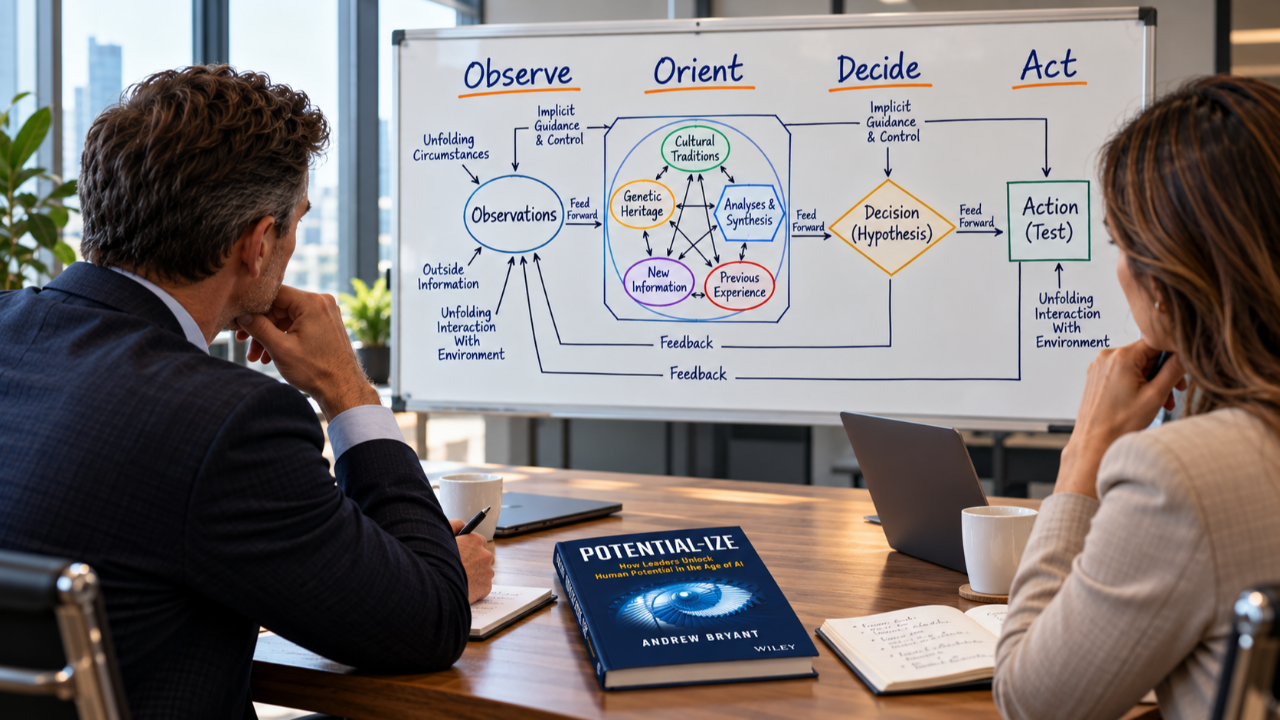
The OODA loop, John Boyd's Observe, Orient, Decide, Act model, is one of the most copied diagrams in leadership, and almost every copy is wrong. Boyd never drew it as a tidy circle, and he put Orientation in the center box, not speed. In POTENTIAL-IZE (Wiley, 2026), I argue that the IGNITE framework is how leaders build that Orientation in their people before the crisis arrives.
Put more bluntly: your crisis decisions were made years ago. That is the uncomfortable conclusion hiding in Boyd's own sketch.
What is the OODA loop? (And why the circle on your slide is not what Boyd drew)
You have seen it on a hundred slides. Four boxes in a circle, arrows chasing each other round: Observe, Orient, Decide, Act. John Boyd, the fighter pilot and strategist who gave us the term, used the phrase "OODA loops" in his briefings from the 1970s onward. Yet according to Chet Richards, who worked alongside him, Boyd develops and draws the loop only in his final short briefing, The Essence of Winning and Losing, produced in 1995, two years before he died (Richards, 2020).
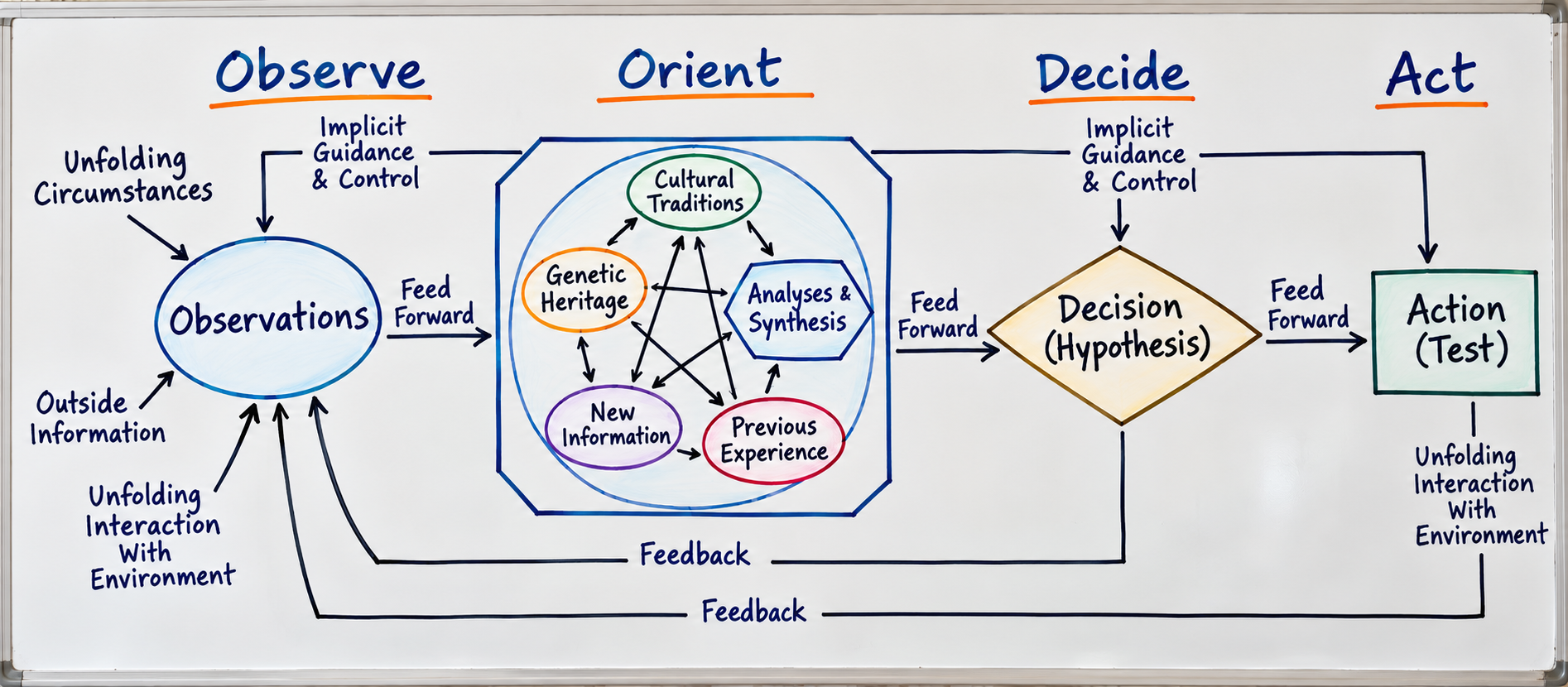
Based on John Boyd's OODA loop sketch in The Essence of Winning and Losing (1995). Redrawn by Self Leadership International.
Look at Boyd's sketch, redrawn here from Grant Hammond's edition of Boyd's work, A Discourse on Winning and Losing (Air University Press, 2018, p. 384, as corrected in the publisher's errata sheet), and three things jump out.
- First, Decide is labeled "Hypothesis," and Act is labeled "Test."
- Second, arrows labeled "Implicit Guidance and Control" run from Orientation straight to Action, skipping Decide altogether, and from Orientation back to Observation.
- Third, Orientation is not a box you pass through. It is the big box in the middle, and inside it sit five things: genetic heritage, cultural traditions, previous experiences, new information, and analyses and synthesis.
So the man who invented the loop was telling us three things.
- A decision is a guess you are about to test
- Skilled people often act without a separate decision step
- The engine of the whole thing builds over a lifetime
Orientation is the center of gravity, not speed
The popular version of OODA is a speed message: cycle faster than the other side, and you win. Frans Osinga, in his doctoral study of Boyd's strategic theory, warns that the simplified diagram "tends towards an exclusive focus on speed of decision making, while obscuring various other themes" (Osinga, 2005).
Boyd himself was blunt about where the weight sits. In his 1987 briefing, Organic Design for Command and Control, he wrote: "Orientation is the Schwerpunkt." The Schwerpunkt is the center of gravity, the point of main effort. Orientation, he said, "shapes the way we observe, the way we decide, the way we act" (as quoted by Chet Richards).
Now put that next to a crisis. A cyberattack at 2 a.m. A product recall. A key client walking. Nobody has time to build better judgment in those moments. Your people will observe what experience has trained them to notice, through whatever filters they already carry. The crisis does not teach. It examines.
That is why so much of what works in leadership in times of crisis turns out to have been done before the crisis started. The quality of a crisis decision is set long in advance, by how people were developed.
Many organizations have this backward. They invest in crisis playbooks, an explicit Decide box written in advance, and very little in the Orientation of the people who must read the situation when the playbook doesn't fit. A playbook is a prescription written before the diagnosis. In my first career as a physiotherapist, I learned a maxim that has never left me: prescription without diagnosis is malpractice.
OODA and IGNITE: two tools, two jobs
OODA explains how a single decision gets made, how well and how fast. It is a model of the moment.
IGNITE is a model of the years before the moment. It is the system I use with leadership teams to execute strategy and prepare people for disruption: building, deliberately and over time, the Orientation the loop will run on when it counts. Use IGNITE as a crisis decision loop, and it would lose to OODA on OODA's own terms. That is not its job. Its job is to feed the box Boyd called the center of gravity.
In POTENTIAL-IZE, I set out the IGNITE framework as six elements:
- Inspire: find your spark and take control of your story.
- Guide: navigate with wisdom through mentorship, feedback, and a clear roadmap.
- Nurture: create the conditions for growth through belief and belonging.
- Integrate: embed new behaviors and AI capabilities into existing systems and practices.
- Transform: use challenges as catalysts for identity shifts that sustain behavior change.
- Evaluate: measure what matters and close the feedback loop.
IGNITE is not a checklist. Each element builds on the one before, which is why a weak Nurture quietly undermines everything that follows.
Why Orientation is a self-leadership problem
In 2012, Ana Kazan and I defined self-leadership this way: "Self-leadership is the practice of intentionally influencing your thinking, feelings, and actions toward your objectives." (Bryant & Kazan, Self Leadership, McGraw-Hill, 2012.)
Read that beside Boyd's Orientation box. Orientation is your thinking and feelings about what is happening, shaped by what you have lived through. Self-leadership is the practice of influencing exactly that, on purpose, and its three competencies map onto it directly.
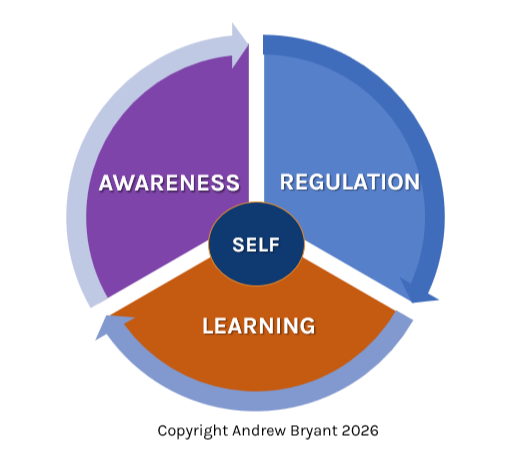
Self-awareness: knowing your own filters
Boyd listed genetic heritage, cultural traditions and previous experiences as the raw material of Orientation. A leader short on self-awareness mistakes those filters for reality. In a crisis, that is the executive who sees a supply problem because they came up through operations, when the real problem is reputational.
Self-regulation: keeping Orientation intact under threat
Fear narrows what we notice and what we are willing to consider. Self-regulation is not suppressing the fear. It is choosing how to respond to it, so Orientation keeps working when the stakes rise.
Self-learning: how Orientation updates
Boyd's box contains new information and analyses and synthesis, and his feedback arrows run from Action back to Observation. That is a learning system. A leader without self-learning runs yesterday's Orientation against today's situation.
Then there is the Driver and Passenger distinction I use in POTENTIAL-IZE. A passenger in a crisis waits to be told. Their loop runs through their boss's loop, and Boyd noted that "as the number of events we must consider increase, the longer it takes to observe-orient-decide-act." Stack enough passengers under one decision-maker and the whole organization slows to the pace of its most overloaded person. A driver acts on implicit guidance, inside the intent, without waiting for permission. That is what Boyd's arrows from Orientation to Action describe.
Boyd saw this as a property of organizations, not only of individuals: "Without a common outlook, superiors cannot give subordinates freedom-of-action and maintain coherency of ongoing action." What goes unsaid only works when people share an Orientation, and shared Orientation is built through development, not through a memo issued in the middle of a crisis. Build the habit in yourself and the culture in your team.
Tempo, not haste: what "getting inside the loop" really means
Boyd's language in Patterns of Conflict is to "operate at a faster tempo or rhythm than our adversaries" and to "get inside adversary's Observation-Orientation-Decision-Action time cycle or loop." That is about rhythm relative to someone else, and about being hard to read. It is not about being hasty. A leader who rushes to Decide on a weak Orientation is not getting inside anybody's loop. They are making the wrong call sooner.
AI makes this sharper, not softer. It accelerates Observe dramatically and can draft options for Decide in seconds. If speed of information were the advantage, everyone with the same tools would arrive at the same advantage. What does not converge is Orientation: what your people notice, what they make of it, and whether they can act on it without calling a meeting. AI widens Observe; it cannot own Orient. That is why human judgment has to stay in the loop. AI is the co-pilot, not the pilot.
How IGNITE builds what the OODA loop runs on
| IGNITE element | What it builds in people | Where it lands in Boyd's sketch | Question to ask before a crisis |
|---|---|---|---|
| Inspire | Purpose and ownership of the story | Shared intent, the "harmonizing agent" Boyd described, which lets implicit guidance work | Would my team make the same call I would if they could not reach me? |
| Guide | Wisdom through mentorship and feedback | Previous experiences, and analyses and synthesis, inside Orientation | Who on my team has been taken through a hard decision rather than handed the answer? |
| Nurture | Belief and belonging | Honest observation, and the trust implicit guidance depends on | Will people bring me bad news early, or will I hear it last? |
| Integrate | Human judgment combined with AI capability | Outside and new information, fed into Orientation without replacing it | Do my people know when to trust the tool and when to override it? |
| Transform | Challenge turned into a catalyst | Action as Test: rehearsing under pressure builds repertoire | When did my team last practice a decision under real pressure? |
| Evaluate | Continuous learning | The feedback arrows, and re-orientation after every loop | What did our last near-miss change about how we see things? |
Using the OODA loop before, during, and after a crisis
Before: build the Orientation you will need
This is where IGNITE does almost all of its work, and where most of the leverage sits.
- Diagnose before you prescribe. Rate yourself and your team on each of the six IGNITE elements and find the weakest. A team strong on Inspire and weak on Nurture will share a purpose and hide bad news. You want to know that now, not at 2 a.m.
- Make intent common. Make purpose and priorities so clear that your team could predict your call.
- Grow drivers, not passengers. Guide through questions rather than answers. Every decision you make for someone they could have made themselves is Orientation you didn't build.
- Rehearse. Boyd's Act is a Test. Give people safe tests before the real one: scenario exercises and stretch assignments.
In POTENTIAL-IZE I tell the story of Kevin Gaskell and Porsche's UK business in 1991. The business was in serious trouble, and the board was replaced. Kevin and his finance manager walked in with a plan they had already built, and within minutes they had the two top jobs. Kevin became the CEO at 32 because, when the moment came, his Orientation was already prepared. The crisis did not create that. It revealed it.
During: run the loop you built
Here OODA leads, and self-leadership keeps it honest.
- Regulate first. Before you Observe, check your own state. A frightened Orientation sees threats everywhere and options nowhere. I have written separately about the practices for decision-making under pressure, and this is where they earn their keep.
- Observe wide, then orient deliberately. Ask the person whose background is least like yours what they are seeing.
- Treat every decision as a hypothesis. Boyd labeled Decide "Hypothesis" for a reason. Say it out loud to your team: this is our best read, and here is what would tell us we are wrong.
- Let people act on intent. Pulling every decision to the top lengthens the loop for everyone.
After: re-orient, do not just debrief
This is Evaluate, and it closes Boyd's feedback loop.
- Ask what changed in how you see, not only what went wrong. A debrief that produces a new checklist has updated the playbook. A debrief that changes how people read situations has updated Orientation. That second kind is double-loop learning, and it is the only kind that makes the next crisis easier.
- Feed the gaps back into development. Whatever the crisis exposed becomes the next round of Guide, Nurture and Transform.
Where the OODA loop and IGNITE break down
Honesty about the limits makes both tools more useful.
The OODA loop
- Boyd built it for conflict against a thinking adversary. Many business crises have no opponent, only events. Getting inside a flood's loop means nothing, so read tempo as keeping pace with how fast the situation is changing.
- It is easy to misread. The historian Michael Hankins, in Flying Camelot (Cornell University Press, 2021), argues that the concept is vague enough for its defenders and its critics to each find in it what they are looking for. The four-box circle invites a pure speed reading that Boyd's own sketch does not support.
- It names the ingredients of Orientation but offers no method for building them. That is the gap IGNITE fills.
IGNITE
- It is not a crisis protocol. It works over months and years. If the crisis is already here, IGNITE has either done its work or it has not.
- It is easy to corrupt. In POTENTIAL-IZE I use WeWork to show how each element can serve manipulation rather than development. Shared purpose without honest Nurture produces a team that rallies around a bad call.
- It shows its value late, which is why development is the first thing cut in a budget squeeze.
Both together
- Neither replaces specialist crisis expertise. Orientation tells you when to call the expert. It does not make you one.
The question to leave with
Boyd spent his career on how decisions get made under pressure, and the last thing he drew put Orientation at the center. I have spent mine on how people develop the capability to lead themselves, and I keep arriving at the same place from the other direction.
So ask yourself the one question worth asking before the next crisis arrives: if everything went wrong tomorrow, whose Orientation would you be relying on, and what have you done this year to develop it?
If the answer worries you, that is a conversation I have with every executive leadership team I work with. And if you want your whole conference to sit with the question, it is the work I bring as a leadership speaker.
Frequently asked questions
What is the OODA loop?
The OODA loop is John Boyd's four-part model of how people and organizations make decisions: Observe, Orient, Decide, Act. Boyd, a US Air Force fighter pilot and strategist, used the term from the 1970s, but he drew the loop in full only once, in his 1995 briefing The Essence of Winning and Losing, with Orientation at its center.
What does Orientation mean in the OODA loop?
Orientation is the set of filters a person brings to a situation. Boyd's sketch lists five inputs: genetic heritage, cultural traditions, previous experiences, new information, and analyses and synthesis. In his 1987 briefing Organic Design for Command and Control, he called Orientation the Schwerpunkt, the center of gravity, because it shapes how we observe, decide and act.
Did John Boyd draw the OODA loop as a circle?
No. Boyd's own sketch is not a four-box circle. It labels Decide as Hypothesis and Act as Test, shows implicit guidance and control running from Orientation straight to Action, and carries feedback arrows back to Observation. The sketch appears in Grant Hammond's edition of Boyd's A Discourse on Winning and Losing (Air University Press, 2018).
Is the OODA loop about making decisions faster?
No. Boyd wrote about operating at a faster tempo or rhythm than an adversary, which is about pace relative to an opponent or a changing situation, not haste. A weak Orientation decided quickly is still a weak decision. The scholar Frans Osinga warns that the simplified diagram encourages an exclusive focus on speed that Boyd's wider work does not support.
How do leaders use the OODA loop in a crisis?
Leaders regulate their own state first, observe wide, treat each decision as a hypothesis to test, and let people act on shared intent rather than pulling every call to the top. The quality of that loop is set by the Orientation people built before the crisis, which is why preparation matters more than the playbook.
How does the IGNITE framework relate to the OODA loop?
They do different jobs. In POTENTIAL-IZE (Wiley, 2026), Andrew Bryant sets out IGNITE (Inspire, Guide, Nurture, Integrate, Transform, Evaluate) as the development system that builds Orientation in people over time. The OODA loop runs the decision in the moment; IGNITE prepares the people who run it, which makes it a tool for strategy execution and preparation for disruption.
Turn Insight Into ActionReading about leadership can change what you know.Self-leadership changes what you do.Develop your leadership effectiveness → Explore Self-leadership Discover your leadership strengths & gaps → Choose an Executive Coach Unlock the potential of your team → Workshops & Masterclasses Ignite your event or conference → Book Andrew Bryant as your Leadership Speaker "Prescription without diagnosis is malpractice" |