
Why Insecure Leaders Micromanage
Nov 02, 2026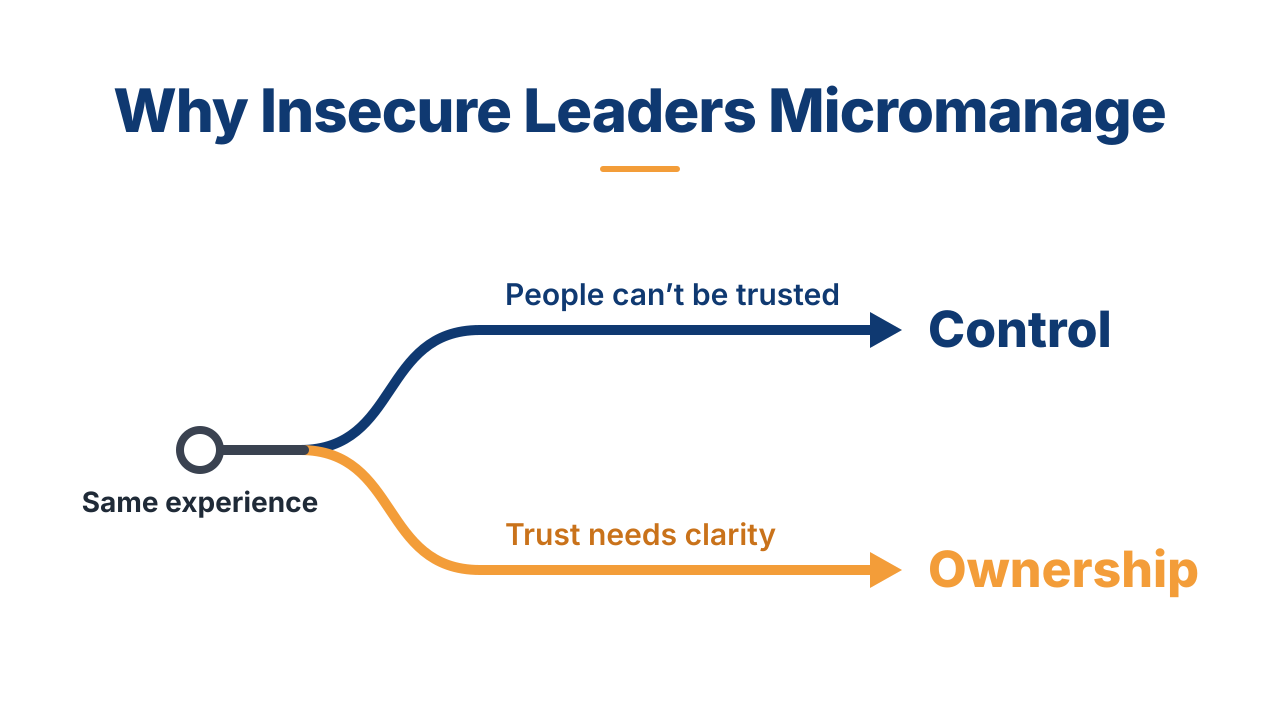
Last updated: November 2, 2026
Two leaders can suffer exactly the same betrayal and walk away with opposite ways of leading.
Picture two senior leaders, each let down badly by someone they trusted. A colleague took credit, hid a problem, or walked out with a client. The first concludes, "People can't be trusted." Within a year, she is demanding constant updates, approving every decision, and reading every email before it goes out. The second concludes, "Trust needs clarity and accountability." He sets clearer expectations, agrees on how progress will be visible, and then lets his people get on with it.
Same experience. Different interpretation. Very different leadership impact.
Nearly a hundred years ago, a Viennese doctor explained why. His name was Alfred Adler, and if you've read The Courage to Be Disliked, you have already met his ideas, even if you didn't know whose they were. Adler matters to anyone who leads, because he showed how a private insecurity becomes a public practice. In leadership, that public practice lands on your team.
What Alfred Adler Said About Meaning, and Why Leaders Should Care
Adler was a physician who worked alongside Sigmund Freud and then broke with him in 1911 to found his own school, Individual Psychology. Freud looked backward for causes. Adler looked forward, at the goals a person is moving toward, and at the meaning they make of what happens to them.
In What Life Should Mean to You (1931), he put it in one line:
"We are self-determined by the meaning we give to our experiences."
He followed it with an even sharper one: "Meanings are not determined by situations, but we determine ourselves by the meanings we give to situations."
Read that as a leader, and it is both a relief and a warning. The relief is that your history doesn't lock you into a style. The warning is that you are already choosing a meaning, whether you notice it or not, and your team lives inside that choice. I've written separately about the meaning you assign to events and how to work with it, so I won't repeat that here. This post is about what Adler adds: why some meanings turn into control.
Why The Courage to Be Disliked Brought Adler Back

For most people I meet, Adler was introduced to them through a book written long after his death. Ichiro Kishimi, a Japanese philosopher and Adler scholar, and the writer Fumitake Koga turned Adlerian psychology into a conversation between a philosopher and a skeptical young man over five nights. It was published in Japan in 2013 and in English in 2018, and it found readers far beyond psychology.
Its appeal is the same thing that makes Adler useful to leaders. It refuses to let the past be an alibi. The young man keeps reaching for his history to explain his unhappiness, and the philosopher keeps turning him back to the question of what he is using that history for.
Where I part company with how the book is often summarized is the next idea, because it's the one most leaders get backward.
Striving for Superiority: The Part Most Summaries Get Wrong
When I first posted about Adler on LinkedIn, I wrote that psychological maturity comes from contribution, not the pursuit of superiority. That is true as far as it goes, but it makes Adler sound as if striving is the problem. It isn't.
Adler saw striving for superiority as universal. Every one of us starts life small and dependent, and every one of us feels some sense of inferiority. That feeling is not a defect. It's the engine. It makes a child learn to walk, and an adult learn to lead.
What matters, in Adlerian psychology, is the direction of the striving. It can run toward personal superiority, which is overcompensation: proving I'm better than you so I never have to feel small again. Or it can run toward what Adler called Gemeinschaftsgefühl, usually translated as social interest or community feeling: using my effort to contribute to something larger than myself.
So the micromanager is not someone who has stopped striving. She is striving hard. She is just striving in the wrong direction. Her energy goes into protecting her own standing rather than into making the team better. That is good news, because you don't have to manufacture drive in a leader like that. You have to redirect it.
How a Leader's Insecurity Becomes the Team's Problem
The danger is that leaders turn personal insecurities into organizational practices, and the translation is so smooth that nobody notices.
- A fear of failure becomes micromanagement.
- A need for approval becomes conflict avoidance.
- A need to prove competence becomes an inability to delegate.
Each of these looks responsible from the inside. The micromanager believes she is maintaining standards. The conflict avoider believes he is keeping the peace. The leader who can't delegate believes it's quicker to do it himself. And each is quietly making the team responsible for managing the leader's insecurity.
Without self-awareness, this is invisible to the person doing it. That's why so many leaders genuinely don't understand why their people stopped taking initiative. If you run leadership development, it's also why a program that teaches delegation skills to someone whose real issue is fear of failure rarely changes anything back at work.
A Self-Diagnosis: Which Insecurity Is Running Your Leadership?
Before I started coaching leaders, I was a physiotherapist, and the first rule I learned there still governs how I work: prescription without diagnosis is malpractice. You don't treat the knee until you've checked the hip. In leadership, the visible behavior is the knee. The insecurity driving it is the hip.
Read across each row and notice which one stings.
| The insecurity | What the leader does | What the team experiences | The redirect question |
|---|---|---|---|
| Fear of failure | Micromanages: checks every detail, asks for constant updates, rewrites work before it goes out | People stop taking initiative and wait to be told. The leader becomes the bottleneck. | Am I protecting the outcome, or protecting myself from being seen to fail? |
| Need for approval | Avoids conflict: softens feedback until it means nothing, delays hard calls, says yes to everyone | Problems go unnamed. Strong performers carry weak ones. Decisions drift. | Whose approval am I keeping by staying quiet, and what is it costing my team? |
| Need to prove competence | Can't delegate: holds on to the visible, interesting work and solves problems others could solve | People stay junior and stop growing. The leader is overloaded, and the team is underused. | If someone else did this well, would I feel relieved or threatened? |
Three ways to use it:
- Pick the row that made you uncomfortable, not the one you'd like to have. Discomfort is diagnostic.
- Check the middle column with your team, not your own opinion. Ask one trusted person, "When do I get in your way?" and listen without defending.
- Ask the redirect question at the moment the behavior shows up, not afterward in a review. That's when you have a choice.
Nothing to Prove, Only Things to Improve
There's a mantra I share with my executive coaching clients: "I have nothing to prove, only things to improve."
It is Adler's redirection in eight words. "Nothing to prove" lets go of personal superiority. "Things to improve" keeps the striving and points it at growth and contribution. You lose none of your drive. You just stop spending it on your image.
When leaders stop trying to prove their worth, they create space for others to demonstrate theirs. They replace control with accountability, defensiveness with curiosity, and the need to be right with the commitment to get better. Build that habit in yourself, and it becomes a culture in your team.
This is why self-leadership has to come before leading others. As Ana Kazan and I defined it in Self Leadership (McGraw-Hill, 2012), "Self-leadership is the practice of intentionally influencing your thinking, feelings, and actions toward your objectives." In practice, it asks us to examine the beliefs driving our behavior, to regulate our responses when an old insecurity fires, and to learn more effective ways to lead.
AI Amplifies the Leader You Already Are
One more reason this matters now. AI tools don't change a leader's patterns. They scale them. Give a controlling leader AI, and you've given her a faster way to control: more dashboards, more tracking, more ways to check work that didn't need checking. Give the same tools to a leader who trusts through clarity, and his people get more room and better support.
Beware of buying technology to fix what is really a self-leadership problem. AI is the co-pilot, not the pilot, and it will fly in whatever direction the leader is already heading.
Your Past Explains Your Patterns. It Doesn't Excuse Their Impact.
Adler gave us permission to stop being prisoners of our history. He did not give us permission to make our teams prisoners of it. Your past may explain your leadership patterns, but it doesn't excuse their impact.
So the question is not simply, "What made me the leader I am?" It's this: what kind of leader do I need to become for my people to thrive?
Frequently Asked Questions
What does Alfred Adler's psychology say about leadership?
Adler didn't write about leadership directly, but Individual Psychology applies to it closely. He argued that we are shaped less by our experiences than by the meaning we give them, and that everyone strives to overcome feelings of inferiority. For a leader, that means behaviors like micromanagement or conflict avoidance are often attempts to protect a personal sense of worth. Healthy leadership redirects that striving toward contribution to the team.
Did Adler think striving for superiority was bad?
No. Adler saw striving for superiority as universal and natural, a response to the sense of inferiority everyone feels. What he cared about was its direction. Striving for personal superiority, proving you are better than others, turns into overcompensation. Striving guided by social interest, or Gemeinschaftsgefühl, turns into contribution.
Why do insecure leaders micromanage?
Usually because they fear failure. If a leader believes a mistake on the team would expose them, checking and controlling every detail feels like protection. The cost lands on the team: people stop taking initiative, and the leader becomes the bottleneck. The fix starts with diagnosing the fear, not with a delegation technique.
What does "I have nothing to prove, only things to improve" mean?
It's a mantra I use with executive coaching clients. "Nothing to prove" lets go of the need to establish your worth through status or control. "Things to improve" keeps your drive and points it at growth and contribution. It's a practical way to apply Adler's shift from personal superiority to social interest.
Is The Courage to Be Disliked based on Alfred Adler?
Yes. The Courage to Be Disliked by Ichiro Kishimi and Fumitake Koga presents Adlerian psychology as a dialogue between a philosopher and a young man. Leaders who found the book useful will find that the same ideas apply directly to how they lead, especially Adler's point that the past explains us but doesn't decide for us.
Turn Insight Into ActionReading about leadership can change what you know.Self-leadership changes what you do.Develop your leadership effectiveness → Explore Self-leadership Discover your leadership strengths & gaps → Choose an Executive Coach Unlock the potential of your team → Workshops & Masterclasses Ignite your event or conference → Book Andrew Bryant as your Leadership Speaker "Prescription without diagnosis is malpractice" |