
Self-Leadership vs. Situational Leadership: Which One Actually Changes Behavior?
Aug 27, 2026
Last updated: August 28, 2026
Situational Leadership is probably the most widely taught leadership model of the last fifty years. It has been printed in millions of training manuals, delivered in thousands of corporate workshops, and quoted by managers who couldn't tell you the theory behind it but can absolutely tell you to "adapt your style."
The observable and self-evident truth- that leaders need to be self-aware and adaptable is, I think, why it has remained so popular. However, despite being one of the most widely known theories in managerial leadership, researchers in the field have consistently found it to be among the least well-substantiated leadership models. Even the textbooks written specifically about leadership tend to flag the same thing: a model this popular should not have this little evidence behind it.
In my 25+ years as a leadership speaker and self-leadership coach, I've seen organizations invest heavily in models like this one, hoping a framework for managing other people would resolve something that actually starts closer to home. Often it only gets you partway there. That gap between what we're taught about leading others and what we actually need to lead ourselves is the very reason self-leadership exists as a discipline.
What Situational Leadership Actually Says
Paul Hersey and Ken Blanchard built the model in the 1970s on a simple, appealing idea: there's no single best way to lead. See, Leadership Practice: Why One Style Never Works.
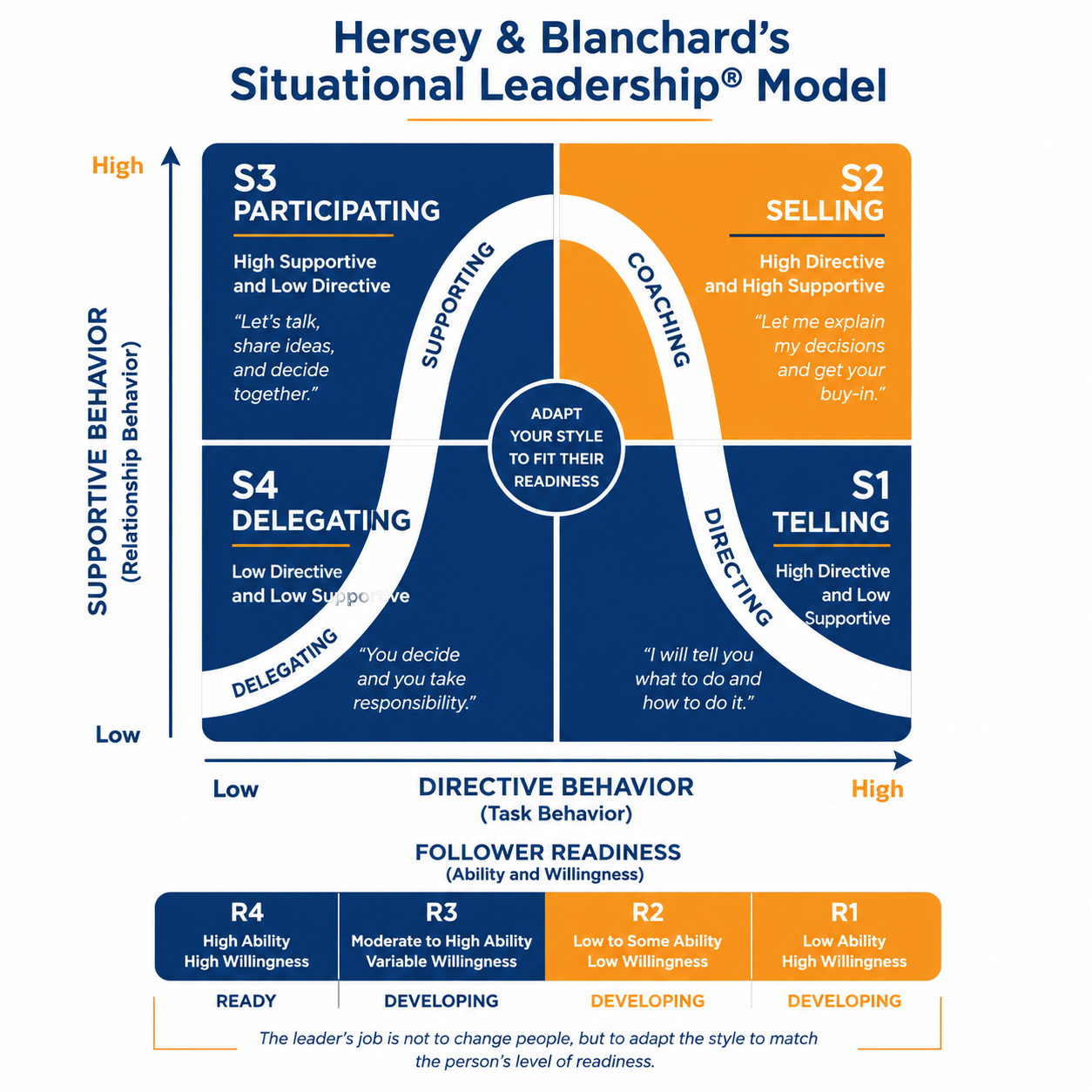
The right style depends on the person in front of you and how "ready" they are for the task, meaning their competence and their commitment. Leaders are told to shift between four styles, telling, selling, participating, and delegating, as their people mature.
It's intuitive. It's teachable in an afternoon. And that's exactly why it spread everywhere from hospital wards to Fortune 500 boardrooms.
But intuitive isn't the same as reliable. The model asks a manager to accurately diagnose someone else's readiness level in real time and then switch styles accordingly, a two-step judgment call that turns out to be far harder in practice than in the workshop slide. Critics have pointed to the same weak spot for decades: the concept of "readiness" or "maturity" is vague, the four styles overlap more than the model admits, and the tools for measuring any of it were never built on solid research. It's a framework for managing other people that assumes the leader doing the diagnosing is already operating from a stable, self-aware place. Most of the time, that assumption doesn't hold. See Self-Awareness at Work: The Leadership Skill You Think You Have (But Probably Don't).
What Self-Leadership Asks Instead
Self-leadership starts one layer down. Before you can accurately read someone else's readiness, you need to be able to read your own state, your own triggers, your own default patterns under pressure. That's not a leadership style. It's an internal operating system.
I came to this decades ago through my experience in physiotherapy and elite sport, not through a business school. In that world, you learn fast that you cannot prescribe a treatment without first diagnosing what's actually wrong. Prescription without diagnosis is malpractice. Most leadership development does exactly that. It hands people a style to apply without ever checking whether they have the self-awareness, self-regulation, and self-learning to apply it consistently, which is the three-competency foundation I built my self-leadership practice on.
I once worked with a regional director who had been trained thoroughly in situational leadership. He could describe all four styles perfectly. But under deadline pressure, he reverted to "telling" with everyone, regardless of their skill or experience, because that was his own default stress response, not a considered read of the team. He wasn't failing to apply the model. He was failing to notice his own state clearly enough to apply anything at all. Six months of self-leadership work later, mostly focused on self-regulation under pressure, he finally had the internal capacity to use the situational tools he'd been carrying around unused the whole time.
That's the relationship between the two. Situational Leadership is a set of external levers. Self-leadership is what determines whether you can actually pull the right one when it counts.
Where the Two Genuinely Complement Each Other
Hersey and Blanchard's work is valuable and has stood the test of time. Diagnosing what a team member needs is a real and useful skill, and there are moments where a more directive style is exactly right and moments where it clearly isn't. The situational lens is a useful map.
What upgrades the model is a driver who can read the map and make informed choices. That's where the IGNITE Framework comes in for the leaders I coach: it builds the internal capacity of self-awareness first, then regulation, then the ability to keep learning from your own mistakes- that makes any external leadership model practical and usable rather than just aspirational. You can hand someone a beautifully designed style-matching chart, but if they can't notice when their own ego, fatigue, or fear is driving the interaction, the chart stays a chart.
The Evidence Gap Nobody Talks About in Workshops
Here's what makes this comparison worth making publicly rather than just privately. It isn't a matter of taste between two philosophies. One side of this comparison has the data. The other doesn't.
Situational Leadership, as covered above, has never built a solid empirical base despite fifty years of popularity. Self-leadership has the opposite problem: it's one of the more thoroughly tested constructs in organizational psychology, and most people teaching leadership have never looked at the research.
A 2022 meta-analysis by Knotts and colleagues pooled 57 effect sizes across more than 16,000 observations and found a reliable, positive relationship between self-leadership and individual outcomes, with the effect even stronger for creativity and innovation than for routine task performance. A separate meta-analytic review by Krampitz and colleagues in 2021 examined whether self-leadership can be trained rather than treated as a fixed trait, drawing on 11 intervention studies involving 571 leaders and found a significant, medium-sized effect. Self-awareness, self-efficacy, and goal attainment all moved. A 2025 systematic review covering 52 studies linked self-leadership development to stress resilience, job performance, and a leader's ability to organize and motivate a team, which is precisely the outcome Situational Leadership promises yet struggles to provide evidence for.
Fifty years of Situational Leadership training and a persistent shortage of solid evidence that it changes anything. Four decades of self-leadership research, across dozens of countries and industries, and a consistent, replicated signal that it does. I've put the full bibliography, including the meta-analyses, cross-cultural studies, and independent institutional citations of my own work with Ana Kazan, on the Self-Leadership Research hub if you want to check any of it yourself rather than take my word for it.
Why This Distinction Matters More Now, Not Less
AI is quietly finishing off the case for teaching people more external frameworks to memorize. Diagnosing a task, matching a style, following a decision tree; these are exactly the kinds of pattern-matching activities that software will do faster and more consistently than a stressed manager ever will. What AI cannot do is sit with your own discomfort, catch your own reactive pattern before it fires, or choose who you want to be under pressure. That's the argument I make at length in my book, POTENTIAL-IZE: How Leaders Unlock Human Potential in the Age of AI. As the tactical layer of leadership gets automated, the premium shifts hard toward the one thing that was never really about technique in the first place: your capacity to lead yourself.
Situational Leadership will continue to be taught because it's simple and feels actionable. But simple isn't the same as sufficient. If you want your leaders to actually use the styles they've been trained in, start by asking whether they can lead themselves first. Everything else is a lever with no one steady enough to pull it.
Frequently Asked Questions
What is the main difference between self-leadership and situational leadership?
Situational Leadership focuses on the follower: it asks a leader to diagnose someone else's readiness and adapt their style accordingly. Self-leadership focuses on the leader's own internal state: their self-awareness, self-regulation, and self-learning. One is an external, relational model; the other is an internal, personal one.
Who developed situational leadership and self-leadership theory?
Situational Leadership was developed by Paul Hersey and Ken Blanchard in the 1970s. Self-leadership theory originated with Charles Manz in the 1980s, with Andrew Bryant and Ana Kazan later contributing an applied framework in their 2012 book Self Leadership.
Does situational leadership have strong research support?
No. Despite being one of the most widely taught leadership models for fifty years, researchers have consistently found situational leadership to be among the least well-substantiated leadership models, with vague core concepts like readiness and maturity that were never built on solid empirical research.
Is self-leadership more evidence-based than situational leadership?
Yes. Self-leadership is one of the more thoroughly tested constructs in organizational psychology. Meta-analyses, including Knotts et al. (2022) and Krampitz et al. (2021), show reliable, replicated effects across countries, industries, and outcome types, in contrast to situational leadership's persistent evidence gap.
Can self-leadership and situational leadership be used together?
Yes. The two are complementary rather than competing. Situational Leadership gives a leader an external model for adjusting style to a team member's needs, while self-leadership provides the internal capacity, self-awareness, regulation, and learning, needed to actually notice and apply that model consistently, especially under pressure.
If you want to upgrade yourself and your team, check out our self-leadership training, workshops, and masterclasses.
Turn Insight Into ActionReading about leadership can change what you know.Self-leadership changes what you do.Develop your leadership effectiveness → Explore Self-leadership Discover your leadership strengths & gaps → Choose an Executive Coach Unlock the potential of your team → Workshops & Masterclasses Ignite your event or conference → Book Andrew Bryant as your Leadership Speaker "Prescription without diagnosis is malpractice" |